
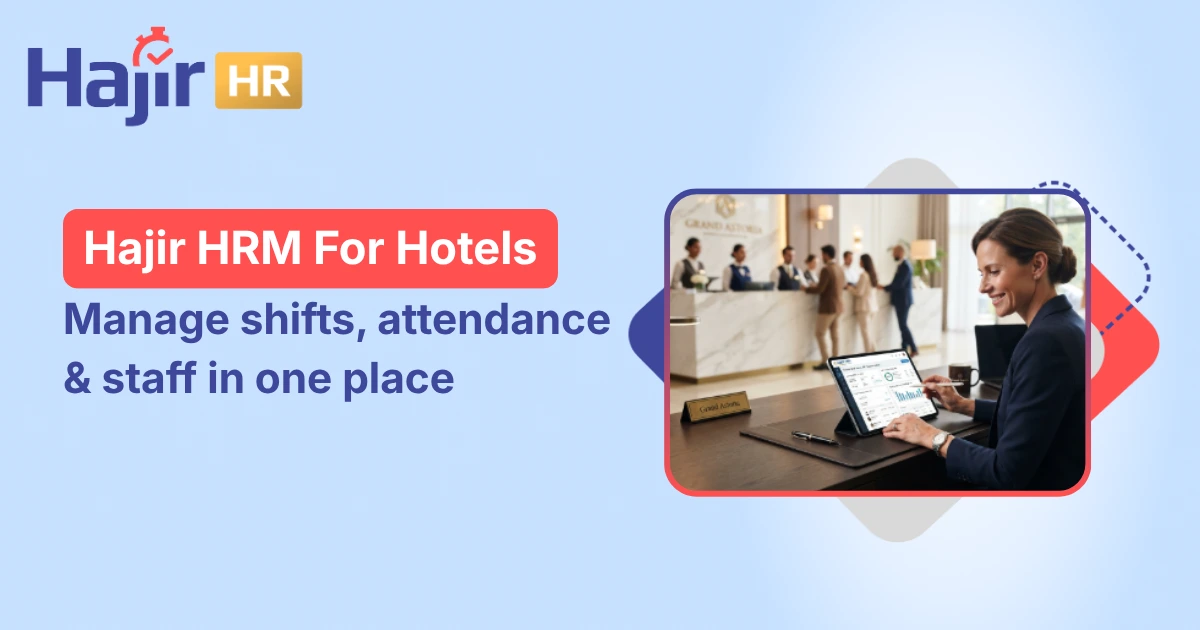
Hajir HRM for Hotels: Manage shifts, attendance & staff in one place
HRM for Hotels has now become the foundation of any successful hospitality operations throughout the world. The hotels are people, not rooms, amenities or reservations. A hotel’s employee performance is evident in guest service from the moment they arrive to the time they leave. Valuing, training and supporting employees means that they will deliver better guest experiences. This is where HRM is a strategic role and not just a day-to-day administrative duty.
Constantly turning over staff, seasonal demand and ever increasing guest expectations are all putting pressure on modern hotels. In the most erratic of times, a structured HR approach is a way to ensure uniformity in hotels. It also fosters an environment in which employees wish to remain and develop in the long run. Today, Hospitality HR software is transforming the way properties efficiently recruit, schedule and retain talent. This is a change that must be acknowledged by hotel owners, GMs and HR professionals.

Recent Post
Why HRM for Hotels Matters More Than Ever
In the hospitality industry, margins are thin and expectations are high, and when it comes to human resource management, the key is to get it right. Typical hotel roles include unpredictable work schedules, working in multiple languages, and employees in various hotel departments, such as housekeeping and food and beverage. Without a dedicated HR system in place, you will have a host of moving parts that will cause you lots of stress.
HRM in hotels assures the uniformity of standards in the various departments with respect to hiring, training and performance. It also safeguards hotels against possible compliance issues with regards to working hours, wages, and labor. HR impacts on more than operations; it shapes the emotional experience of a property. A sense of being valued by others is directly linked to reviews and repeat bookings and is passed on to guests by employees.
Core Functions of Hotel Human Resource Management
Hotel HR is not just about processing payroll or filling out paperwork. It interacts with almost all phases of employee’s experiences in the property.
Recruitment and Onboarding
One of the major difficulties for hotels is the need to find the right personnel in a short amount of time, particularly during the busy season. An effective HR system helps to schedule jobs, screen and interview candidates to ensure vacancies are filled quickly. With structured onboarding, new employees get oriented to brand standards, safety protocols, and expectations for service from the get-go. Hotels that go through onboarding know that their new employees are more productive and less likely to leave the job in the early days.
Training and Skill Development
The expectations of guests are continually changing and it is important that staff are continuously training. HRM for Hotels involves creating training schedules on front desk manners, housekeeping protocols, and food safety. Cross training of employees in various departments also helps in times of manpower shortage. A well-trained team will have fewer mistakes to make and more confidence in dealing with guest complaints.
Employee Scheduling and Tracking
Hotels run 24 hours a day, thus making hotel scheduling one of the most challenging human resource tasks. Planning for shift coverage, employee preferences and cost of labour is key. Many properties are now implementing automating of their workforce management and real-timeattendance tracking with hotelworkforce managementtools. This helps to eliminate the last minute staff shortage and helps employees avoid burnout due to irregular working hours.
Payroll and Compliance
Employer’s confidence in employees is gained and maintained through accurate payroll, particularly in an industry where tips, overtime and shift variation are present. HR departments need to also keep abreast of the various laws and regulations related to labor in various regions and property types. Failure to comply may result in fines, litigation, and/or damage to reputation. Payroll is kept transparent and audit-ready at all times thanks to a well-organized HR system.
How HR Software for Hotels Improves Efficiency
For hotels with dozens or hundreds of employees, manual spreadsheet or paper filing is no longer practical. Hospitality HR software integrates all employee data from recruitment to attendance and payroll. Managers can instantly see how many staff are working on each shift and each department. This visibility is used to reduce over staffing during low demand times and under staffing during periods of high demand. Many platforms also haveself-service portals so that employees can apply for leave or find out schedules without having to speak to anyone. This allows HR teams to allocate more time to strategic tasks such as retention planning and building company culture, and less on paperwork.
Building a Culture of Retention in Hospitality
One of the leading financial costs for any hotel around the world is high turnover. It’s a lot more expensive to continually hire and train new workers than to pay the bills for experienced workers. It is a great deal more likely that employees will stay with their hotel if they are able to see a clearly defined path for their growth and development within the company. Engagement also includes recognition programs, fair scheduling and open lines ofcommunication. The right use of exit interviews can help uncover common problems that HR can solve before it’s too late to save more talent. Hotels that focus on retaining customers as a proactive measure rather than a measure taken as a last resort consistently report higher service quality, reduced recruitment expenses, etc.
Challenges Hotels Face in HR Management
Although HR is crucial in the hotel industry, it has its own set of challenges. Businesses often struggle to predict the demand for labor all year long, due to seasonal swings in both high and low demand. Staff language and/or culture may cause issues with consistency of communication and training. Limited HR budgets is also a challenge for many properties, particularly smaller independent properties that are trying to beat out the competition of bigger chains. In addition, because some hospitality jobs are not formal, it is more difficult to standardize the HR practices within the hotel industry than in the traditional office environment.
Awareness of these problems at an early stage enables hotel management to plan out HR strategies that are not just theoretical but also realistic and sustainable. Unexpected pressures on the HR budget, such as an economic downturn or a change in travel patterns, can also create a challenge for teams to do more with less. For most hotel HRs, cost control andemployee wellness are constant conflicts.
The Role of Leadership in HRM for Hotels
HR policies are only effective if they are supported by the leaders at the hotel. The attitude of the frontline towards HR initiatives is determined by the general managers and department heads. If the leaders behave with respect towards one another and with fairness, then the employees will also do the same with guests. Leadership participation also aids in HR identifying problems early on before they get to the formal complaint or resignation level. Feedback is not something that can be captured in a policy document; it’s a process that happens between supervisors and staff on a regular basis. Hotels that implementHuman Resource Management for Hotels as a team responsibility, as opposed to a team responsibility, usually experience a more efficient day to day running of their hotel and fewer internal disagreements.
Measuring the Impact of Hotel HR Practices
For hotels, it may be hard to demonstrate the value of their investment in HR without the right metrics. By measuring turnover, time-to-hire, and training completion, HR leaders can start to measure the impact of their initiatives on business results. Guest satisfaction scores can also be correlated with the number of employees on duty and the length of the employee’s service to find significant trends. Another good indicator is absenteeism rates, a high number of absences can be a sign of burnout or low morale before it is apparent in other ways. It’s important to check these metrics quarterly to allow HR teams to make changes before issues arise. This is data-driven, and over time, the HR practices in the hotel sector transform from cost centre to a measurable contributor to profitability.
Technology Beyond HR in Hotel Operations
HRM is a fundamental part of a successful hotel, but it must go hand-in-hand with other operating technology. How staff are trained and scheduled connects to the Property Management System, Revenue Management, and Guest Experience Platform. The possibilities of how these systems can work with HR information can help hotel operators see even more efficiencies when they’re looking to upgrade the whole hotel, not just their HR processes.
Frequently Asked Questions (FAQ)
In the Hotel setting, HRM refers to any activity that is related to recruitment, training, work scheduling, compensation management, or employee relations in the hospitality industry.
HR can assist hotels to ensure that they have well-trained and inspired employees, thereby influencing guest satisfaction, uniformity of service, and business results.
One of the biggest challenges faced by hotel HR teams is high employee turnover, as a result of seasonal demands and working hours.
Yes, even small properties can reduce administrative workload and improve scheduling accuracy by adopting affordable hospitality HR software.
The quality of staffing and training leads to a more attentive and consistent service which directly affects guests' perceptions of their stay.