SSF Tax Deduction in Nepal: How Your Contributions Lower Your Salary Tax
Now, if an employee in Nepal is aware about SSF tax deduction, then he/she can retain the maximum portion of their monthly salary. TheSocial Security Fund has become the main retirement and protection scheme for private sector workers. Your employer automatically deposits part of your basic salary into the fund every month. Many workers see this figure on their payslip, but they rarely ask how it affects their tax. As a result, they may overpay tax and miss out on savings.
Fast Onboarding
Secure Cloud-Based
Employee Self-Service
Rs 500,000 deduction cap
31% to SSF
No 1% SST
Insurance deductible
The Income Tax Act of Nepal treats retirement deposits favourably. For example, you can deduct money you place in an approved fund from your taxable income, up to a certain limit. In addition, the Finance Act has modified the first tax slab rules for fund members. This matters because payroll teams apply these updates every month when they calculate tax deducted at source.
This page explains the basic rules. It covers the contribution rates, the deduction cap, the SST waiver, and a simple worked example. It also gives employers a quick reference guide for the payroll side. However, each Finance Act can change the rules, so please check the latest figures with the Inland Revenue Department.
Who is in the Social Security fund and who must join?
TheSocial Security Fund (SSF) was established in the Social Security Act of 2018. It is replacing the old schemes like PF and gratuity of the enrolled employers. All registered businesses are required to register their employees including contract and part-time workers. The regular contribution of SSF is 31% of basic salary per month.
The employees will pay 11 percent and the employers will pay 20 percent. This money provides retirement, medical, accident and maternity benefits. The contributions are compulsory and therefore the amount of the retirement fund deduction for tax calculation is based on the base.
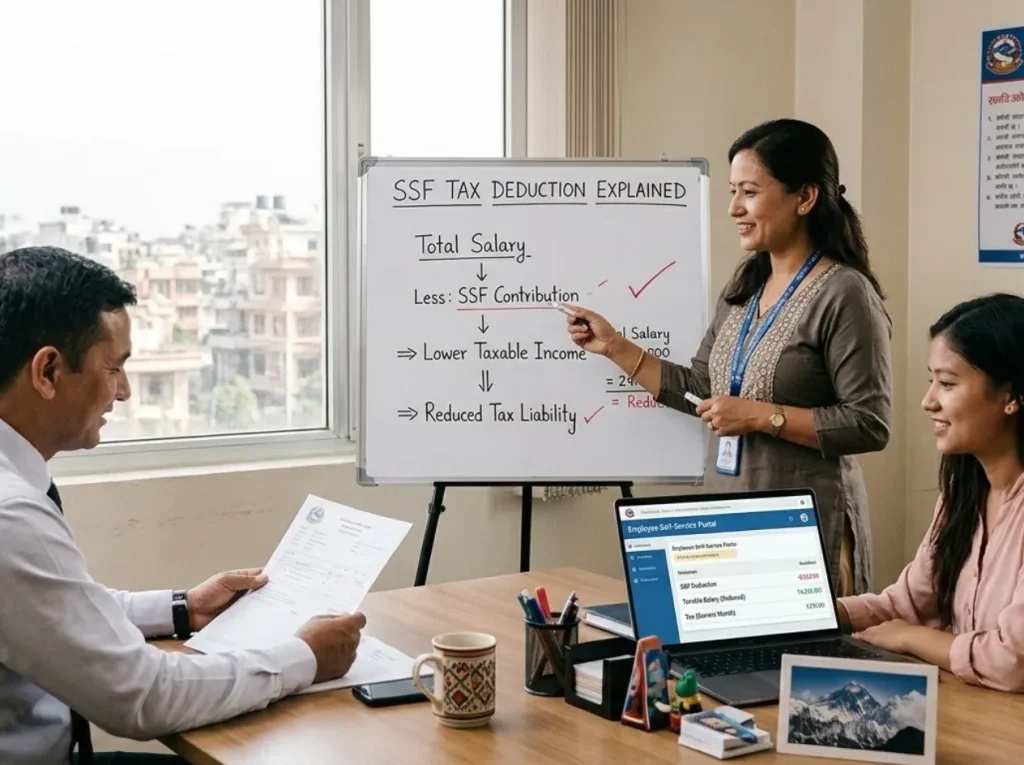
How SSF Tax Deduction Is Calculated on Your Salary
Nepal offers tax relief on retirement contributions in calculating taxable income. The payments made by SSF,Citizen Investment Trust and approved provident fund are consolidated. The law caps your total deduction at Rs 500,000 or one-third of your assessable income, whichever is lower. Sometimes both of these limits exceed the amount you actually contribute. In that case, you deduct only the amount you contributed.
This is very clear from a simple example. Assume that your annual assessable income is Rs 1,200,000. Rs 400,000 is one-third of that figure. The total amount of your contributions to SSF and CIT is Rs 450,000. Its deductible limit is Rs 400,000. The income you will pay tax on then becomes Rs 800,000 less other deductions.
The 1% Social Security Tax Waiver for SSF Members
In Nepal the first slab of income is subject to a 1% Social Security Tax (SST). Staff members who make contributions to the fund will not be asked to pay this 1 per cent. They already perform the social security role, so it wouldn’t be worth having a second levy. In the reports ofFinance Act 2083/84, there is a first slab of Rs 1,000,000. They further say that there is a waiver for members of SSF as well. Slabs are then followed by higher slabs, in this instance the highest rate being 29 percent. For the actual slab table please refer to the official Finance Act or the Inland Revenue Department notice.
Other deductions available to be combined with your SSF deduction
Retirement savings is just one aspect of “smart tax planning.” You can deduct up to Rs 40,000 per year in life insurance premiums. The law limits health insurance deductions to Rs 20,000. It also gives women a 10 per cent rebate on computed tax. Make sure to keep all premium receipts, as you might need them for your claim. You can combine these benefits, and this may lower your taxable income even more. The government updates limits annually, so please check the current numbers before making plans.
Common Mistakes That Reduce Your SSF Tax Deduction
There are a lot of mistakes many employees make in losing part of their benefit. Some are adding the CIT contribution without considering the combined cap. Anything over the limit doesn’t contribute to any additional tax break. Payroll teams might sometimes take out the tax as payment first, before it is properly recorded. This will result in a higher monthly tax deduction at source. No other workers ever look at their yearly tax statement. Small payroll errors go unnoticed then until the year’s end. Employers’ late payments can also cause compliance issues and record keeping problems. Getting a monthly pay slip helps to avoid most of these issues.
How Employers Can Handle SSF Tax Deduction Correctly
It is the practical responsibility of the employer to make correct deductions. Payroll teams must work out taxable earnings from basic pay, pay the right tax on time, and apply the correct tax treatment. These steps are cumbersome and inefficient when using manual spreadsheets, particularly as the team expands. Payroll software likeHajir HRM can compute contributions, implement the limit on retirement deduction and automatically create payslips. Automated records also come in handy when it comes to audits and annual reporting. Having a clearly defined compensation plan from day one decreases grievance issues. Trust is created through accurate payroll, and good employees stay for longer.
Frequently Asked Questions (FAQ)
The portion of your SSF deductions that is not taxable as assessable income. It shares a single cap with the contributions to CIT andprovident fund.
Limit is Rs 500,000 or 1/3 of assessable income whichever is lower.
No. There is no exemption of 1% SST on the first slab for the employees who contribute to the SSF.
Absolutely you can donate to both! But the total amount of deductions will not exceed the total retirement cap.
Read through the Finance Act, the Inland Revenue Department page on the Internet and the official Social Security Fund notices. Limits and slabs are subject to change from year to year.
Trusted by 1600+ Organisations
Why to Choose Hajir?
Efficiently manage payroll, leave, and communication to streamline
HR processes and enhance employee satisfaction.
HR processes and enhance employee satisfaction.
Cost Effective Solution
Automates manual processes, saving businesses on administrative costs and resources.
Cloud-Based Accessibility
Access your data anytime, anywhere—perfect for remote and hybrid work environments.
Customizable Features
Adaptable to your business needs, with features like shift scheduling, WPS compliance, and custom reporting.
User-Friendly Interface
Designed for simplicity, ensuring a smooth experience for both HR teams and employees.
Data Security & Compliance
Robust security measures protect sensitive employee information, meeting regional compliance standards.
Quick Implementation
Hassle-free setup and onboarding process that gets your HR operations up and running in no time.
Scalability
Whether for small businesses or large enterprises, it can scale to meet the needs of any organization.
Boost Employee Productivity
With automated processes and real-time updates, Hajir helps you focus on what matters most—growing your business
12h/6d Customer Support
Dedicated support ensures that your HR operations run without a hitch.
Download the App and Get Started
Get the app from Play Store and App Store