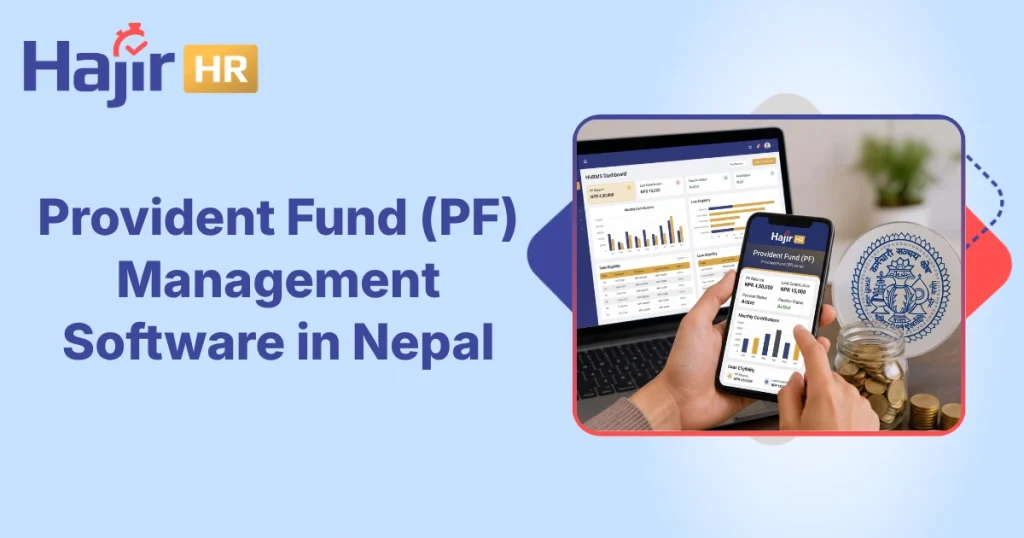
Provident Fund (PF) Management Software in Nepal
The Provident Fund (PF) Management Software offers a solution for helping Nepali businesses to calculate, track and manage Provident Fund contributions without having to rely on manual spreadsheets.
HR teams often have difficulty working out the right 10% split between the employee and employer despite the basic salary structures changing regularly, and new staff being added to the payroll half way through the month..
Thankfully, modern HR platforms address this issue head-on. As a result, companies that use automated PF tools ensure fewer mistakes, save on processing time, and develop more trust with the employees about thepayroll process.
What is Provident Fund Management Software?
Provident Fund management software is a digital solution for HR that automates Provident Fund and compliance calculations, tracking and reporting for employers. This type of platform can automatically calculate the employee and employer shares as well as 10% deductions on basic salary each month.
In particular, it is generally software that is capable of managing:
- The default 10% contribution towards the plan is calculated automatically.
- Easy-to-follow payment report with instant updates following salary changes.
- Records of the compliance contribution of employees on an employee-wise basis.
- Tracking transfer of PFCs between phases (PF-to-SSF)
- HR audit ready reports
Why Manual PF Tracking Fails Growing Teams
Manual works for a 5-person office. After about twenty or thirty people in a company, however, spreadsheets get increasingly unwieldy and errors begin to compound with each payroll period.
Common PF Calculation Errors:
In fact, Provident Fund management software is available because manual formulas are inefficient at scale. Typical mistakes include:
Using gross salary rather than basic salary for calculating PF.
- Failure to receive mid-year salary increases.
- Employer side matching contributions are not a factor.
- Failure to retain those employees who have transferred from PF to SSF
- Inaccurate payroll record-keeping (schedules and EPF claims)
This means HR professionals spend more time fixing payroll errors instead of improving employee experience and planning for the future.
Compliance Risks Without Automation
If not automated, compliance is a month-by-month manual audit. Common risks include:
- Late submissions with penalties incurred for EPF’s
- Wrong basic salaries calculation
- Accurate payroll sheets can vary from one worker to another
- Bad audit trails during compliance audits
Also, when these errors are made they can be easily spotted by employees and over time repeatedly committing the same errors can affect the credibility of HR.
A Simple PF Calculation Example
Imagine that one of the workers has a minimum salary of NPR 30,000 monthly. If the game is played according to the PF rules:
- Employee contribution: 10% of NPR 30,000 = NPR 3,000
- Employer contribution: 10% of NPR 30,000 = NPR 3,000
- Monthly contribution: NPR 500
- The annual contribution (before interest) is NPR 72,000.
This number can be tedious to calculate manually for 50 or 100 people – with each person having their own base salary and revision date.Automated payroll software, however, can do this calculation in an instant for each employee, and with no risk of a calculation error.
Core Features to Look for in Provident Fund Management Software
Not every HR system deals with PF in the very same manner. There are some that provide basic calculation, and others that integrate PF directly into payroll, attendance and compliance reporting. When considering your choices, make sure you consider the following essential features.
Automatic PF Calculation
A strong platform can automatically compute the 10% deduction and matching contribution from the 10% of each employee’s basic salary. The system recalculates the contribution automatically without the HR having to do any manual work as soon as the salary structure changes.
Payslip and Payroll Integration
The right tool is not just a separate spreadsheet, but it is part of the payroll process. Otherwise, HR teams waste time and risk errors by having to enter the same data repeatedly. Accurate numbers are pushed straight onto payslips with integrated systems, so that employees are seeing the data they need, without any need to guess.
Compliance-Ready Reports
A reliable solution produces employee contribution reports on the fly anytime during the payroll lifecycle. These reports ease internal audits and enable a much easier response to EPF queries or sudden EPF checks.
PF-to-SSF Transfer Tracking
Not only that, good Provident Fund management software should also keep a record of the previous PF balances while transitioning to SSF, as many of the employers have been shifted toSSF in Nepal. This is important because the confusion of the un-resolved transfers is an issue for HR teams and employees who aren’t certain where their retirement savings are located.
Manual Tracking vs. Automated Software
Manual spreadsheets and automated payroll platforms handle the same task very differently, and the difference becomes obvious once a company starts scaling.
Task | Manual Spreadsheet | Provident Fund Management Software |
Monthly calculation | Done by hand, per employee | Calculated automatically |
Salary revision updates | Requires manual re-entry | Recalculates instantly |
Compliance reports | Built manually each time | Generated on demand |
PF-to-SSF tracking | Tracked separately, error-prone | Tracked within the same system |
Payslip accuracy | Depends on the person updating it | Consistent across every employee |
As the table shows, automation removes the human dependency that makes manual tracking so fragile.
Benefits of Using Provident Fund Management Software
An automated platform offers tangible advantages on HR, finance and employee experience all in all.
- Lower payroll errors: Manual formula errors are eliminated with automated calculations.
- Reduced payroll cycles: HR teams get payroll done sooner without manual PF checks.
- Improved compliance readiness: Reports remain up-to-date and audit-ready.
- More employee trust: Clear payslips means fewer repeated payroll enquiries.
- Better scaling: For growing teams, contribution management is accurate, no matter how many people are on the team.
In brief, excellent Provident Fund administration software simplifies a mundane and error-prone duty right into an automated and reliable procedure that HR groups can rely on each and every month.
How HajirHRM Brings PF, SSF, and TDS Together
HajirHRM embarked on tackling this exact challenge for businesses in Nepal. Hajir HRM’sPayroll Compliance Softwareintegrates contribution calculations with your payroll, attendance, and leave data to streamline the spreadsheet process.
One Unified View for HR and Finance
Consequently, HR teams receive one true source of information for PF, SSF and TDS deductions for each employee without having to navigate through dis-joined tools. Likewise, finance teams can extract compliance ready reports at any time and for any purpose such as an audit or just for internal review.
Automatic Payslip Updates
Furthermore, whenever you change the amount of contributions on a salary revision, Hajir HRM will automatically update payslips. Thus, correct, timely deductions are always visible to the employees, and HR does not have to manually perform mid-cycle deductions. In the end, this integrated approach eliminates all the “guesstimates” inherent in manual PF tracking.
Getting Started: Implementing PF Tools in HajirHRM
You don’t need to implement an overly complex rollout of a spreadsheet to an automated system:
- Enter employee details: Enter the employee basic salary and their existing PF or SSF status in Hajir HRM.
- Apply contribution rules:Contribution rules are automatically calculated by the platform.
- Run payroll normally: HajirHR automatically calculates PF, SSF and TDS deduction on a single step without any additional spreadsheet steps.
- Generatecompliance reports: HR or financial teams create reports for auditing, as necessary.
So, the whole process typically takes days not months and employees don’t experience any disruption in their payslips.
Who Needs Provident Fund Management Software?
Switching to an automated system is advantageous for any Nepali business that handles employee PF, SSF or transition accounts, such as:
- Structured payroll systemsfor growing SMEs leaving spreadsheets behind.
- Firms with old PF accounts and new SSF registrations.
- HR teams with various departments or locations in branches.HR teams with multiple departments or branches.
- Finance teams who are actively involved in compliance audits
Finally, if a lot of your HR staff’s time is being wasted trying to manually verify PF numbers each month, an automated solution will pay for itself many times over.
Quick Checklist: Choosing the Right Software
Prior to registering on any platform, make sure that it has these characteristics:
- Automatically calculates contributions to basic salary
- Seamlessly connects to existing payroll and attendance information
- Can produce a report on compliance whenever required
- Manages SSF and TDS along with PF in one system
- Offers cloud or mobile access for HR teams on the go
Lastly, select a platform that can handle all three – with your HR team never having to coordinate multiple apps for different payroll cycles.
Simplify Provident Fund (PF) Management with Hajir HRM
Manual PF tracking is time-consuming for your HR team and gradually raises the compliance risk. Hajir HRM’s Provident Fund management software automates contribution calculations, integrates with payroll and maintains your records audit-ready each month.
Schedule a free demo withHajir HRM now and experience the seamless management of bookings, PF, SSF, and TDS with your growing team.
FAQ:
Provident Fund management software is an HR solution which automates Provident Fund calculation, keeps track of employee and employer contribution and offers a ready-to-go report for businesses to be compliant.
Not necessarily. The small teams on most cloud-based platforms, like Hajir HRM, only have to pay for what they use, with pricing based on the number of employees.
Yes. Employers in the formal sector have to register eligible employees and pay regularly. Failure to make payments or late payments can lead to penalty from the Employees Provident Fund office.
Late deposit fines, interest charges and increased scrutiny during compliance audits can be a result of late deposits. Automated software helps minimize that risk by notifying users when deadlines are approaching.
Yes. A well-integrated system automatically updates PF contributions when any change is made to salaries; you don't need to manually update it.
With Hajir HRM, HR teams can leverage a single payroll system to sync PF, SSF, and TDS calculations, eliminating repetitive manual efforts for accurate deductions, real-time reporting, and audit-ready records.
Know more about HajirHR. Your All in one HR software.
Get started now!
Recent Post