Payroll Automation in Nepal
Payroll Automation in Nepal is transforming business in terms of employee salary and tax deductions and HR compliance. As a result, organizations are moving to automated systems instead of using manual spreadsheets and time-consuming calculations to make payroll faster, more accurate, and more efficient.
Furthermore, with payroll automation, the whole salary process including the attendance tracking to final payment is simplified. In addition, it is aligned with the taxation rules in Nepal, including TDS, PF and CIT.
Fast Onboarding
Secure Cloud-Based
Employee Self-Service
What is Payroll Automation?
Payroll Automation=Salary Processing + Tax Calculation + Attendance Integration + Compliance.
Payroll automation is the adoption of software to automatically handle the calculation, deduction, tax and payment of salaries of employees without utilizing manual calculations.
Rather than maintaining spreadsheets or paperwork, automated systems handle tasks such as attendance tracking and payslip generation.This minimizes mistakes and provides uniformity in payroll processes.
Considering the Nepal context, local needs such as tax deductions (TDS), Provident Fund (PF) and Citizen Investment Trust (CIT) are also part of payroll automation, which has made it very applicable to the contemporary businesses.
Why Payroll Automation is Important in Nepal
Increasing Business Complexity
As organizations grow, they may find it difficult to handle the payrolls of more and more employees. Paper-based systems find it hard to handle more data and calculations.
Risk of Human Errors
Any little error in computing the salaries or deductions related to taxes can cause severe consequences, such as staff dissatisfaction and fines.
Time-Consuming Processes
HR teams can spend hours in order to process payroll manually, which limits their focus on strategic activities.
Compliance with Nepal Regulations
Nepal has numerous elements in payroll which includes TDS, PF and CIT. These are calculated with automated systems so that they are accurate and consistent.
Key Features of Payroll Automation Software
Payroll automation systems of the modern world are loaded with various features aimed at making HR work easier.
Automated Salary Calculation
The system uses preset structures to calculate the salaries using allowances, bonuses and deductions.
Tax and Compliance Management
Automatically processes TDS and other statutory deductions as per the regulations in Nepal.
Attendance and Leave Integration
Payroll is directly connected with attendance andleave management information, and it will guarantee correct payment of salary.
Payslip Generation
Produces online payslips which employees can view at any time.
Employee Self-Service Portal
Employees are able to see the salary information, pay slips, and monitor their records by themselves.
Multi-Branch Management
Perfect in companies with more than one location, a payroll can be centrally processed.
To explore a complete solution designed for Nepali businesses, check ourPayroll Software in Nepal
Benefits of Payroll Automation in Nepal
Improved Accuracy
Automation reduces errors in calculations, and the employees receive their pay at the right time and at the right amount.
Time Efficiency
Processing that used to take hours to do payroll takes minutes.
Better Compliance
Automated systems assist businesses in keeping abreast with the tax and labor rules in Nepal.
Enhanced Transparency
Employees can have easy access to clear and detailed information on salary, which enhances trust.
Scalability
Business expansion can be easily managed by payroll automation systems without addition of workload.
How Payroll Automation Works in Nepal
Implementing automation of payrolls can help businesses to make the transition.
Step 1: Employee Data Management
The system storesemployee informationlike salary structure, designation as well as tax information.
Step 2: Attendance Integration
The system is a combination of the attendance and leave data to determine the working days and absences.
Step 3: Salary Calculation
The system computes gross salary, deductions, and net pay, based on predetermined rules.
Step 4: Tax and Compliance Processing
Auto-applies TDS, PF, CIT, and other deductions needed.
Step 5: Payslip Generation and Distribution
Employees receive payslips in electronic form, and the system securely stores the records for future reference.
Challenges of Payroll Automation Software in Nepal
Although payroll automation offers numerous advantages, businesses might experience some challenges when implementing it.
Resistance to Change
The management and employees might be reluctant to abandon the conventional systems and adopt digital solutions.
Initial Setup Complexity
The establishment of payroll systems and data transfer will have to be planned.
Lack of Awareness
There are quite a number of small businesses that are still unaware of the advantages of automating payroll.
Data Migration Issues
Without the appropriate support, there might be a challenge in transferring the existing records in a new system.
Who Should Use Payroll Automation?
Payroll automation can be applicable to a variety of organizations:
- Small and medium enterprises (SMES).
- Startups experiencing growth
- Multi-branch companies.
- HR departments dealing with a large number of employees.
Any business that aims to enhance efficiency and reduce manual workload can use payroll automation. By having a specificPayroll Management Software solution, businesses can now efficiently handle the whole payroll cycle without problem in its accuracy and compliance.
How Hajir HRM Simplifies Payroll Automation in Nepal
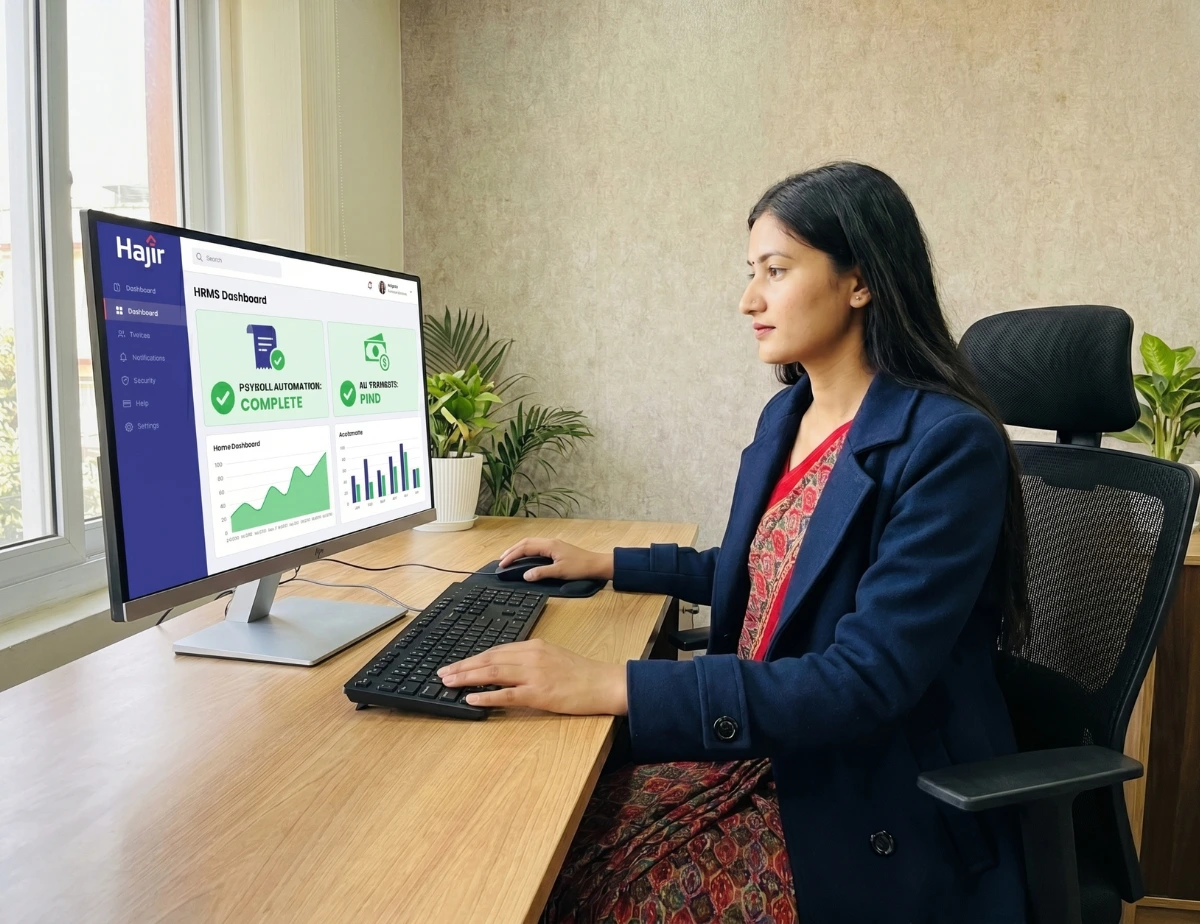
Hajir HRM is aimed at assisting Nepali firms to automate their payroll easily. It also integrates attendance management, leave tracking and payroll processing to a single platform hence avoiding multiple systems.
Local Compliance Support
Deals with Nepal-specific taxation regulations such as TDS, PF and CIT.
User-Friendly Interface
Easy dashboard enabling HR teams to process payrolls easily.
Real-Time Processing
Enables instant payroll calculations and updates.
Cloud-Based Access
Secure cloud technology will provide access to payroll information at any time and location.
Take Control of Payroll with Hajir HRM
Handling payroll manually slows down your HR team and leads to possible expensive mistakes. As business needs in Nepal continue to increase, businesses require a smarter and more reliable solution.
Hajir HRMis an easy-to-use system that will help in the automation of payroll by integrating attendance, leave, salary calculation and compliance in a single strong system made specifically to suit Nepali companies.
✔ Why choose Hajir HRM?
- Automated payroll processing in minutes
- Maximally compliant with the Nepal taxation laws (TDS, PF, CIT).
- Live salary and attendance integration.
- Safe HR system in the cloud.
- Developed to expand SMEs and businesses.
The Future of Payroll Management in Nepal
Payroll automation in Nepal is a necessity to businesses that want to remain competitive and efficient. With the ever-evolving nature of organizations and the rise of more complex rules, manual payroll processes may cause delays, errors, and compliance risks.
Through the introduction of payroll automation, companies will be able to automate HR operations, enhance accuracy, and process salaries in a timely manner. Therefore, companies in Nepal can shift to a smarter and more efficient payroll management approach by using solutions such as Hajir HRM.
Trusted by 1600+ Organisations
Why to Choose Hajir?
HR processes and enhance employee satisfaction.
Cost Effective Solution
Cloud-Based Accessibility
Customizable Features
User-Friendly Interface
Data Security & Compliance
Quick Implementation
Scalability
Boost Employee Productivity
12h/6d Customer Support
Download the App and Get Started