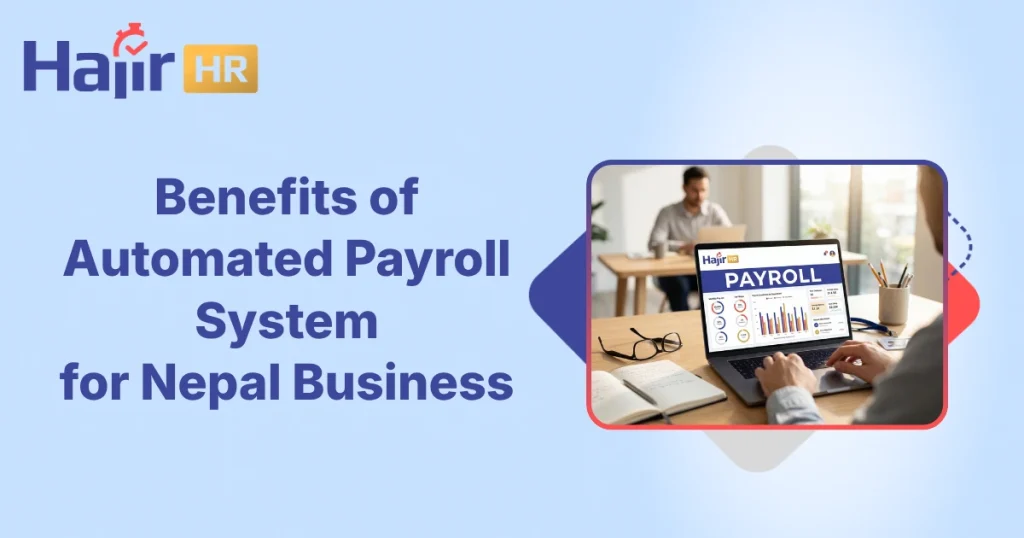
Automated Payroll System: Key Benefits for Businesses in Nepal
For most companies in Nepal, the end of each month follows the same routine: they spend hours manually calculating salaries, double-checking attendance sheets, reconciling tax deductions, and verifying figures before running payroll. This process takes time, creates compliance risks, and leaves little room for error.
An automated payroll system completely changes this cycle. Rule-based automation handles payroll calculations and allows businesses to process salaries accurately, on time, and in full compliance with Nepal’s regulatory requirements—without the stress of manual work.
Why Nepalese Businesses Need Payroll Automation
Payroll automation is an essential component of any business operations. Nepal’s business landscape is changing quickly. The companies are growing faster, the Inland Revenue Department (IRD) is tightening its compliance requirements and the expectations of employees for timely and transparent payments have gone up even more.
Moreover, small and medium-sized enterprises (SMEs) in Nepal are still using spreadsheets and manual computations for payroll. This isn’t only time consuming, but also very likely to make errors that can lead to expensive penalties and bad moods at work.
Therefore, companies that implement payroll automation enjoy a distinct competitive edge as they free up their HR and finance teams to concentrate on growth-related tasks, away from duplicated and also mistake-prone estimations.
Top Benefits of an Automated Payroll System in Nepal
Eliminates Manual Errors and Saves Time
Manual payroll processing includes dozens of calculations – basic salary, allowances, overtime, provident fund deduction and tax withholding – and even a minor error can lead to larger discrepancies in payroll.
With automation, the system calculates everything accurately in seconds. Consequently, your HR team saves hours each month, typically, from data entry, cross-checking, and correcting.
Learn more about manual vs automated payroll to understand the key differences between.
Supports Tax Compliance Based on IRD Regulations in Nepal
The tax system in Nepal varies periodically, featuring the Personal Income Tax, the Social Security Fund (SSF) contributions and Citizen Investment Trust (CIT) deductions. It’s hard—and dangerous—to stay up to date with these updates through manual efforts.
An automated payroll system remains up-to-date with Nepal’s tax regulations. This applies the right tax slab automatically, creates accurate TDS reports, and ensures all deductions comply with IRD regulations.
This means that businesses can rest easy and confidently avoid late filing penalties and disruptions to their business due to compliance.
Streamlines Social Security Fund (SSF) and PF Management
The management of Social Security Fund (SSF) and Provident Fund (PF) is one of the most complicated parts of payroll to manage for employers in Nepal. One of the common problems is calculating the employer and employee contribution, keeping track of submission deadlines and preparing reports to the authorities.
Without manual effort, the system automatically calculates SSF and PF contributions for each worker, produces a report ready for submission and maintains a complete audit trail.
For a detailed breakdown, you can also read about our blog onSSF calculation in Nepal.
Provides Real-Time Payroll Reports and Analytics
Accurate data is essential for the effective planning of workforce budgets by decision makers. An automated payroll system provides real-time reports on payroll costs, department-wise salary breakdown, overtime trends, as well as year over year comparisons — all with a click of a button.
Furthermore, these insights aid business owners and HR managers in Nepal make more smart hiring, salary and budgeting decisions without waiting till the end of the month to reconcile.
Improves Employee Satisfaction with Timely Payments
Payment delays and payments which are not accurate, are among the most common reasons for employee discontent and attrition. Payroll automation ensures timely payroll processing, automatic generation of payslips, and access to payroll information via a self-service portal for employees.
This openness fosters trust. Nepalese workers are demanding digital payslips and quick access to their salary history, tax deductions and leave encashments.
Reduces Operational Costs Over Time
There is an initial investment to be made in payroll software, but the savings are significant in the longterm. Companies save the need for a dedicated payroll person to do manual calculations, minimize expensive payroll mistakes, and save time on paper-based payroll.
Plus, there’s virtually no risk of facing compliance penalties — which could be much more costly than payroll software. As the process of payroll automation continues, it saves many times over.
Supports Multi-Branch and Remote Payroll Management
The expanding business community in Nepal comprises businesses with offices in different cities and districts. Human resource management of employees based in Kathmandu, Biratnagar, Butwal and Pokhara at the same time is challenging.
An automated payroll system stores all payroll-related information on one cloud-based platform. HR managers can process salaries for multiple branches simultaneously, apply location-specific allowances, and pull consolidated reports — all from a single dashboard.
Maintains a Secure and Auditable Payroll Record
Payroll information is confidential. It contains details of personal employees, salary scales, banking details, and tax records. Manual records stored in spreadsheets or physical files risk loss, corruption, and unauthorised access.
A cloud-based system securely stores all data with role-based access controls and encrypted storage. It automatically logs every payroll run with timestamps, creating an irrefutable audit trail that proves invaluable during tax audits or labour disputes
Manual Payroll vs. Automated Payroll: Why the Old Way Is Quietly Costing You More
Manual payroll is a hidden cost center:Manual payroll drains more resources than most businesses realise. Your HR team actively spends hours every month calculating salaries, processing SSF and PF contributions, reconciling TDS, and generating payslips — costs that often exceed an annual payroll software subscription
Human error isn’t a possibility – it’s a statistical probability: it’s said that typical data entry errors range from 1-4%. Every pay cycle risks salary miscalculations, incorrect tax amounts, and SSF mismatches — each one forcing your team to manage employee complaints, run correction cycles, and potentially face IRD fines.
Manual payroll does not scale: When your company crosses 50 or 100 employees, the same manually-generated payroll becomes a burden that affects your hiring and overall decision making time.
Compliance risk compounds over time: Nepal’s IRD rules and SSF rates update regularly, and even one small oversight in a manual system can trigger penalties, back payments, or a full audit.
How HRM Makes Payroll Automation Easy for Nepal Business?
Hajir HRM is designed to fit the business environment in Nepal. It has an integrated attendance tracking, leave management and employee self-service system which means that HR teams have a complete end-to-end HR solution.
With Hajir HRM, you can:
- Process payroll in minutes, not days!
- Fill auto-calculate SSF, PF and TDS as per IRD, Nepal.
- Print a payslip in the blink of an eye in Nepali or English.
- Connect to biometric and attendance systems to provide accurate salary computation.
- Run multi-branch payroll from a single centralised dashboard
Your staff requires little training with Hajir HRM’s user friendly interface and your payroll is always in line with the most recent regulations in Nepal with dedicated local support.
Stop Paying the Price of Manual Payroll: Make the Switch Today
An automated payroll system isn’t merely a tool; it’s an essential investment in your business’s efficiency, compliance, and employee experience. Payroll automation is an unarguable solution for HR management that is scalable, hassle-free and a right choice for businesses in Nepal dealing with intricate tax laws, multiple branches and expanding workforce.
Looking to make payroll simple? Book a free demo withHajir HRMtoday and make a difference with smart automation.
FAQ:
A computer-based system that calculates an employee’s salary, taxes, deductions and benefits according to a certain set of rules, it helps save time & manual calculations, avoids mistakes, and facilitates faster and correct payment for all employees.
Yes. A good automated payroll software such as Hajir HRM follows guidelines such as the IRD (Inland Revenue Department) rules in Nepal, such as the calculation of the TDS correctly, payment of social security fund (SSF) and deduction of provident fund (PF) as per Nepalese labour law.
An automated payroll ensures none of the employees would need to perform manual and tedious calculation, payslip generation and deduction entry of payments each month. HR teams would be able to save a whole month’s worth of payroll in mere minutes, enabling them to invest their time on strategic HR activities.
Absolutely. Advanced payroll automation solutions such as Hajir HRM enable multi-branch, multi-location payrolls for all your businesses to be handled from a single centralised platform. Salary, allowance and deductions of employees can be managed at all the cities at Kathmandu, Pokhara, Biratnagar etc. at once.
SSF is compulsory and provides protection in the event of medical, accident, maternity and pension accidents. The old retirement system was called PF (EPF) and is being replaced by SSF. CIT is a voluntary government sponsored saving and investment scheme which provides significant tax deduction benefits. Today most workers are employed in the private sector and are covered by SSF plus the optional CIT.
Know more about HajirHR. Your All in one HR software.
Get started now!
Recent Post