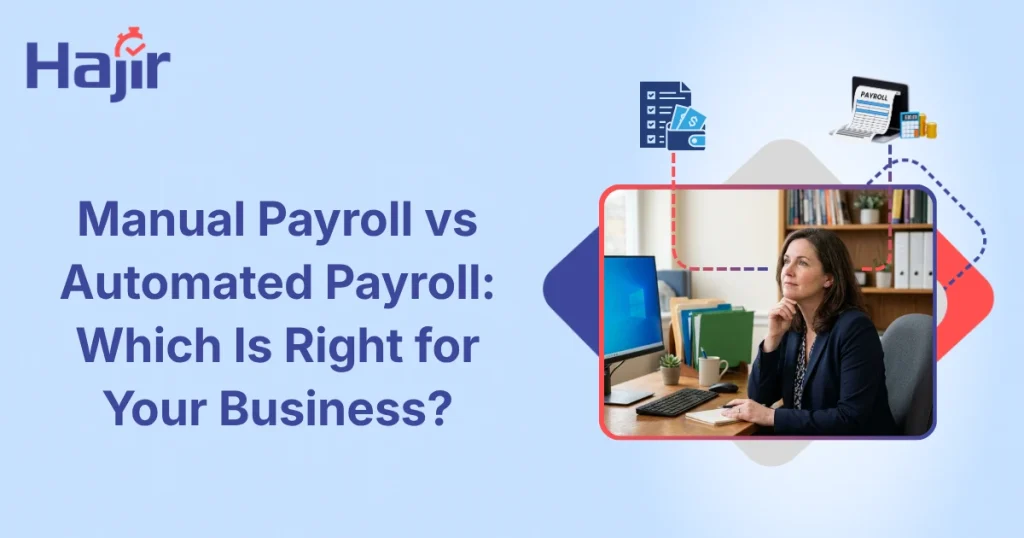
Manual Payroll vs Automated Payroll: Which Is Right for Your Business?
Manual Payroll vs Automated Payroll is a critical comparison for businesses aiming to improve efficiency, accuracy, and compliance. Payroll is not just an administrative task but it directly influences the level of satisfaction among employees, financial transparency and legality. The correct choice of a system can help to reduce errors, wastage of time and help in long term development.
As businesses in Nepal continue to adopt digital solutions, many businesses are shifting towardsautomated payroll systems, leaving behind manual payroll systems. However, the two approaches should be understood well and then the decision on which approach to embrace is made.
What is Manual Payroll?
Manual Payroll is the process of calculating and processing the salaries, deductions and taxes of employees without the use of specialized software, typically through spreadsheets, calculators or paper records.
In this approach, it is the duty of HR or accounting personnel to track attendance, compute wages, and make up payslips in the manual form. This method is all-controlling, but it is time-consuming and strenuous.
Key Features of Manual Payroll
- Manual payroll calculations.
- Large human reliance.
- Limited system integration
- Basic reporting capabilities
Manual payroll can be quite appropriate in the small business but ineffective with the expansion of operations.
What is Automated Payroll?
Automated payroll involves the use of software to process salaries, compute taxes, record attendance and report with little human intervention.
These systems are tailored to facilitate the process of payrolls as well as being accurate and up to date with the regulations.
Key Features of Automated Payroll
- Software-driven payroll processing
- Connection to HR and attendance systems.
- Real-time actions and calculation.
- Automated compliance management
Automation revolutionizes payroll to become a strategic business growth support activity rather than a routine one.
Manual Payroll vs Automated Payroll: Key Differences Explained
Factor | Manual Payroll | Automated Payroll |
Accuracy | Prone to human errors | Highly accurate with system calculations |
Time Required | Time-consuming | Fast and efficient |
Compliance | Difficult to manage | Automatically updated with regulations |
Scalability | Hard to scale | Easily scalable |
Cost | Low initial cost | Long-term cost-effective |
Data Security | Risk of data loss | Secure with backups and access control |
Reporting | Limited insights | Real-time reports and analytics |
Advantages of Manual Payroll
The advantages of manual payroll systems should also be taken into account, especially with small companies with relatively simple payroll requirements.
- Lower upfront cost
- Simple to implement
- Full payroll calculations.
These advantages make manual payroll an alternative that can be considered by start-ups or companies with very few employees.
Disadvantages of Manual Payroll
Although very simple, manual payroll is associated with a number of challenges:
- Large probability of inaccuracies in calculations.
- Time-consuming processes
- Problem with record keeping.
- Limited reporting capabilities
- Increased compliance risks
Manual errors are one of the biggest drawbacks of traditional systems. Many businesses move toward automation to achieve error-free payroll processing and improve accuracy in salary management.
Advantages of Automated Payroll
Manual Payroll vs Automated Payroll is a clear indication of why automation is taking the center stage as the preferred option by businesses.
Improved Accuracy
Predefined formulas and real-time data are used to minimize errors in automated systems.
Time Efficiency
Manually taking hours to complete payroll tasks can be done in minutes.
Better Compliance
Automated payroll makes sure that the laws concerning taxation and labor are adhered to.
Enhanced Data Security
Payroll Information: Sensitive information is safely stored and secured.
Advanced Reporting
Businesses are able to get real-time insights and analytics to make better decisions.
Disadvantages of Automated Payroll
Despite the many benefits associated with automated payroll, it also has a number of weaknesses:
- Initial setup cost
- User-learning curve.
- The dependence on computer applications.
However, these are short-term problems which are offset by long term gains.
Real Business Scenario: Manual vs Automated Payroll
A business that has less than five employees can easily use manual payroll since it is simple. But once the firm reaches 20 or 50 staff, the calculations made in a manual manner are time consuming and subject to inaccuracies.
Conversely, automated payroll systems are capable of managing huge amounts of data easily, thus facilitating proper and timely salary handling. This renders automation as an effective option to expanding companies.
When Should Businesses Switch to Automated Payroll?
Manual Payroll or Automated Payroll is not only a choice point but it is a comparison point as well. Businesses should consider switching to automated payroll when:
- There are frequent payroll errors.
- Processing of salaries is time-consuming.
- The number of employees is growing.
- Compliance becomes difficult
- Reporting is limited
Early awareness of these signs can assist businesses to shift with ease and prevent operational difficulties.
To understand practical solutions, learn more about how to reduce payroll mistakes
Impact on Employee Experience
Payroll systems also have an impact on employee experience. Lateness and inability to fulfill the salary payments can result in dissatisfaction and mistrust.
- Automated payroll ensures:
- Accurate salary calculations
- Timely payments
- Payslips can be easily obtained.
This increases the morale of the workers and job satisfaction.
The Future of Payroll in Modern Businesses
The future of modern business and payroll is directly connected with the general tendency of digital transformation. Cloud based solutions and integration of payroll and HR systems are more easily implemented in the companies.
Future trends include:
- HR process automation.
- Real-timeworkforce analytics
- Seamless system integration
Companies that adopt automation are in a better position to be competitive and efficient.
From Manual Effort to Smart Efficiency: Making the Right Payroll Choice
Manual Payroll vs Automated Payroll ultimately comes down to choosing between traditional practices and modern efficiency. Although manual payroll can be efficient in small organizations, it cannot be expanded and utilized in the long run.
Automated payroll provides a credible, efficient and secure system with the requirements of the present business world. Automation is a sensible move in making the business more productive and compliant.
Upgrade Payroll with Hajir HRM Today
Payroll processing manually may result in inefficiencies in your business operations and errors as your business expands. With an automated payroll process like that provided by Hajir HRM, all processes become more organized and accurate.
Advantages of Hajir HRM:
- Accurate payroll processing without errors
- Efficient payroll processing
- Automatic tax processing
- HR and attendance management system
- Secure storage of employee information
- Electronic payment slips
Hajir HRM makes it easier for companies to have accurate and efficient payroll processing while concentrating on their business rather than HR work.
FAQ
Manual payroll refers to the calculation of salaries through manual calculation whereas automated payroll is calculated using software in order to achieve accuracy and efficiency.
Yes, automated payroll saves time and minimizes errors even with limited staff, saving small businesses time.
Yes, the majority of payroll software is designed to keep in touch with the tax laws and regulations.
Manual payroll is subject to human errors, delays and compliance issues.
The migration normally requires a few days to a few weeks depending on the complexity of the system.
It reduces human errors by automatically calculating salaries, taxes, and deductions based on predefined rules.
Know more about HajirHR. Your All in one HR software.
Get started now!
Recent Post