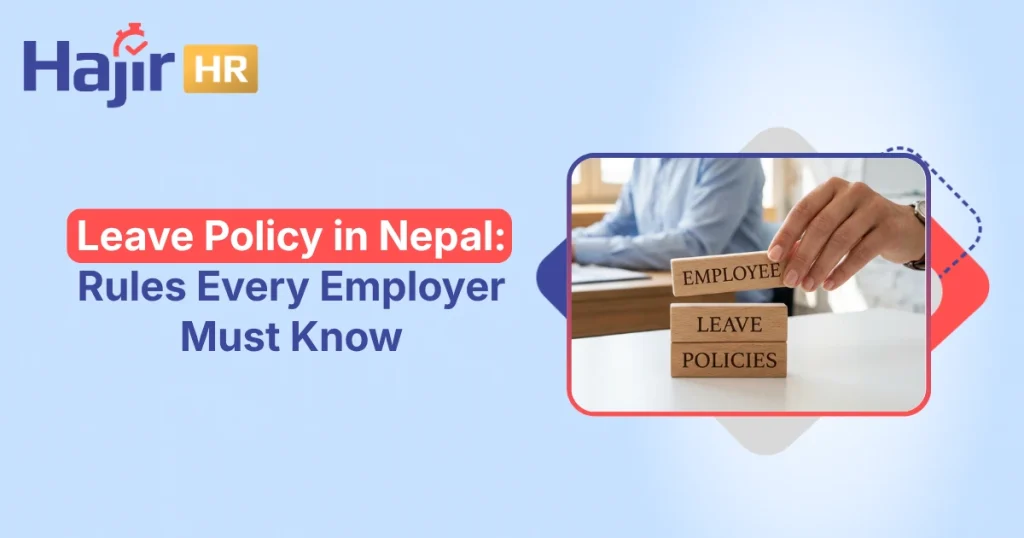
Leave Policy in Nepal: Rules Every Employer Must Know
Leave Policy in Nepal influences the way workers take their rest and recuperate and how they manage their personal life and work. These rules should be well understood by all the employers in Nepal.
A simple and easy to understand guide of Leave Policy in Nepal. It also outlines the benefits of using modernHR software for compliance in expanding companies.
Leave rules impact payroll, staffing, and legal risk all at once so HR teams can’t take leave rules lightly. This article will talk you through all the different types of leaves, encashment rules, eligibility requirements and the common mistakes that employers make when applying the Leave Policy in Nepal.
Understanding the Leave Policy in Nepal
Leave Policy in Nepal originates from the Labour Act, 2074 (2017), along with the Labour Rules, 2075. These laws apply to most formal-sector employers.
Who the Leave Policy in Nepal Applies To
- Private companies, banks, hotels, and schools
- Registered industries and factories
- Corporate offices with formal employment contracts
- Foreign employees working under valid work permits
Why Company Policies Vary
Employers may include additional benefits above and beyond the minimum requirements. For example, some multinational companies provide extra days off to celebrate a festival or wellness days to recruit. Therefore, though leave policy is legally the same for all the organizations, there is a slight variation in Leave Policy among them in Nepal.
Staff should use their contract to check against the statutory minimums at all times. An agreement that provides less than the law’s minimum requires does not meet the legal minimum and is automatically replaced by the law.
Legal Framework Behind the Leave Policy in Nepal
The Leave Policy in Nepal is directly addressed in Chapter 9 of the Labour Act, from Section 40 to 51. Further, the procedural details are added in these sections in the Labour Rules, 2075.
- Labour Act, 2074 specifies all the types of leave and qualification criterion.
- Labour Rules, 2075: Establishes documentation and accrual formula.
- The registered employer may use the Social Security Fund (SSF)to fund the maternity leave.
All three need to be read, before drafting an internal policy, by employers. Otherwise, they and their business may find themselves in trouble if a labour inspector visits their premises.
Types of Leave Under the Leave Policy in Nepal
Leave Policy in Nepal allows a number of different types of leave. Each one has a specific function and is used for various reasons by employees and employers, so there is no need to consider leave as a single pool of leave.
The following is an overview of the different types of leaves, their respective durations and the conditions of their Leave Policy in Nepal.
Annual Leave
- 1 day leave for every 20 days worked.
- This equals approximately 18-21 days a year after 1 year of service.
- Leave pay is at least 50% day’s basic pay per day.
Sick Leave
- Twelve paid sick days per year.
- After 7 consecutive days of sickness, a medical certificate is required.
- Any unused sick leaves can be carried over until the maximum statutory limit
Casual Leave
- Staff members are entitled to 12 casual days of leave a year.
- This leave is for a short notice personal leave.
- It requires no advance planning for the employees.
Festival Leave
- Staff are given up to 3 flexible festival days.
- They can match these days to their religious and/or cultural events.
- There is no restriction on this leave under the Leave Policy of Nepal.
Maternity Leave
- Women employees get 98 days maternity leave altogether
- The first 60-days are fully paid for by the employer.
- If the family is unable to cover the remaining days, they will receive the remaining amount from the Social Security Fund.
- The employees shall be absent for not less than 2 weeks prior to the delivery.
- Staff to be absent for a minimum of 6 weeks following delivery
The Nepal government is planning to increase paid maternity leave from 98 days to six months for working women. If implemented, this would give mothers more time to recover and care for their newborns. The change is currently a proposal and has not yet become law.
Paternity Leave
- Fathers getPaternity Leave with paid days around the birth of the child.
- If the mother dies within 60 days of the child’s birth, the father has the right to claim the rest of the mother’s maternity benefits.
Bereavement Leave
- Employers provide approximately 13 fully paid days of leave for the employee.
- This leave is for the death of a spouse, parent, child or parent-in-law.
Unpaid Leave
- When the statutory categories of unpaid leave are exhausted, employees may apply for unpaid leave.
- This leave is usually given at the discretion of the employer.
Who Qualifies Under the Leave Policy in Nepal
The Leave Policy in Nepal is intended for most of the permanent and full-time employees. Rates are different for probationary, contractual and part-time employees.
Eligibility by Employment Type
- Full-time staff: Take leave from day one; have access to most of it after 12 months on the job.
- The core protections and sick leave provisions also continue to apply to probationary employees.
- Contract staff & fixed term employees: are treated the same as permanent staff under the statute.
- Non-standard work: Leave will be provided on a pro-rata basis, according to hours worked
- Minority workers: Are entitled to the same benefits as majority workers.
If employers classify employees as non-exempt, they could face penalties and back-pay lawsuits. So, it is best for multinational companies to have a one leave policy for the entire staff.
Benefits of Following the Leave Policy in Nepal
An effective Leave Policy in Nepal provides added benefits above and beyond just legal requirements. When an employer closely adheres to it, they may notice better retention and morale rates throughout their organization.
Advantages for Employers
- Increased legal protection in the event of labour audits and inspections
- Reduction in payroll disputes upon employee termination
- More predictable staffing patterns, as leave patterns become predictable
- In a competitive job market, better employer branding.
Advantages for Employees
- Ensured rest/recovery time all year long
- Financial protection in sickness, during childbirth or in case of death.
- Clarity on the accrual and carry forward of leave
- Knowing that their statutory rights are upheld in all situations, no matter how big or small the company is.
Public Holidays and the Leave Policy in Nepal
The Government of Nepal officially declares about 13 public holidays every year. These days are in addition to the normal leave of the employees.
Key Points on Public Holidays
- The most significant period of holidays, other than Christmas, usually falls during the Dashain and Tihar festivals.
- Comps must be provided to employees who are required to work on a holiday or additional compensation shall be provided.
- Holiday dates should be changed annually, as they align to the lunar year.
Leave Encashment and Carry-Forward Rules
Staff have the option to bank their unused leave but with limits imposed by legislation.
Carry-Forward Caps
- Home leave: can be accumulated to a max of 90 days.
- Sick leave: Up to 45 days.
- Any surplus in excess of these caps is paid out as cash at year-end.
Final Settlement Rules
- Employees who resign, retire or die have the ability to cash in all unused home and sick leave.
- The calculation is based on the employee’s basic pay at the end of the contract.
- A lot of emphasis is placed on accuracy – both for the employer and the employee leaving.
Employer Obligations and Penalties
The Leave Policy in Nepal imposes strong responsibilities on employers, rather than employees. Failure to comply may have actual monetary and legal penalties.
What Employers Must Do
- Ensure that leave documents are kept up to date for all staff.
- Give statutory leave without having to give reasons for their personal leave
- Automatically use up any surplus leave at the end of the year.
- Take up unused leave at the time of an employee’s departure.
- Ensure internal policies are updated when there is a change in the Labour Act or Labour Rules.
Consequences of Non-Compliance
- Fines levied on the business by the Department of Labour on the inspection.
- The back-pay claims of current or former employees.
- Damage to reputation (may impact future employment)
- Legal-backlog issues that tie up management time and resources.
These risks are present and employers should have a clear and well-documented leave policy and review it annually.
Common Mistakes Employers Make
A great number of companies have difficulties in implementing the Leave Policy in Nepal uniformly across departments.
Frequent Compliance Errors
- Throwing in the minimum required by statute rather than the optional benefits that may be offered by the company.
- Not properly tracking accrual caps and making the wrong end-of-year payouts
- Because of incorrect calculations, there is a split between employer and SSF in regards tomaternity leave.
- Being unable to maintain historical leave records because of turnover.
- Having different approval processes in different locations
These errors can have tangible, financial and legal implications, which is why more companies are relying on specialized HR software.
How HR Software Strengthens the Leave Policy in Nepal
As businesses expand, manually managing leave becomes very time-intensive. As a result, HR software takes care of the entire leave cycle from setting leave policies to encashment at year-end.
Core Leave Management Features
- Leave types that are configured with the precise legal minimums.
- No need to manually calculate accruals (time tracking)
- A rules engine that sets the carry-forward balances properly
- Employee self-service for applying/balancing balances
- Multiple approval workflows for managers
- Say goodbye to manual payroll reconciliation.
- Reporting and compliance for audit ready documentation
There is no manual updating required as everything happens automatically, saving HR time on paperwork and allowing them to focus on hiring and retention.
Simplify the Leave Policy in Nepal with Hajir HRM
Hajir HRM transforms the Leave Policy in Nepal from a time-consuming, manual affair into a true competitive advantage.
What Hajir HRM Handles for You
- Sets up all statutory leaves automatically
- Computes accruals correctly, without the use of spreadsheets
- Automatically enforces caps on cash outs.
- Allows staff to apply for leave from their phones.
- Lets managers approve requests within seconds
- Bookkeeping is automatically updated in real time in the background of the application.
Ready to simplify compliance for good? Get a freeHajir HRM Demo today and see how easy leave management can be for your business.
FAQ:
It is applicable to most formal sector employers (private firms and registered organizations) but not to all. But sometimes informal or unregistered business may not be in the direct reach of enforcement.
The general rule is that an employee gets 1 day for every 20 days of work, and this equals 18 to 21 days after 1 year of service.
Yes. Employees are allowed to cash out any un-used leave beyond the carry forward limits and are also paid their leave in full in the event of resignation or retirement.
The employer pays the first 60 days at full pay and the Social Security Fund may pay the balance.
HR software eliminates manual mistakes, automates statutory adherence and saves considerable administrative time over a spreadsheet tracking.
The Department of Labour may fine and affected workers can seek back-pay or unpaid encashment. An ongoing pattern of abuse also can hurt an employer's reputation and hiring power over time.
Know more about HajirHR. Your All in one HR software.
Get started now!
Recent Post