10 Key Features to Know About Attendance Tracking App
An attendance tracking app is the backbone of modern HR operations. As a result, businesses no longer have to resort to paper logs or manual spreadsheets to determine who was in and out or who was late to leave. Instead, they resort to digital systems that immediately and precisely record this data.
Furthermore, the transition to remote work, hybrid working, and remote teams has made it difficult to track manual processes at scale. So, whatever your business size, if you need to deal with this important task, you are turning to smart tools to get the job done.
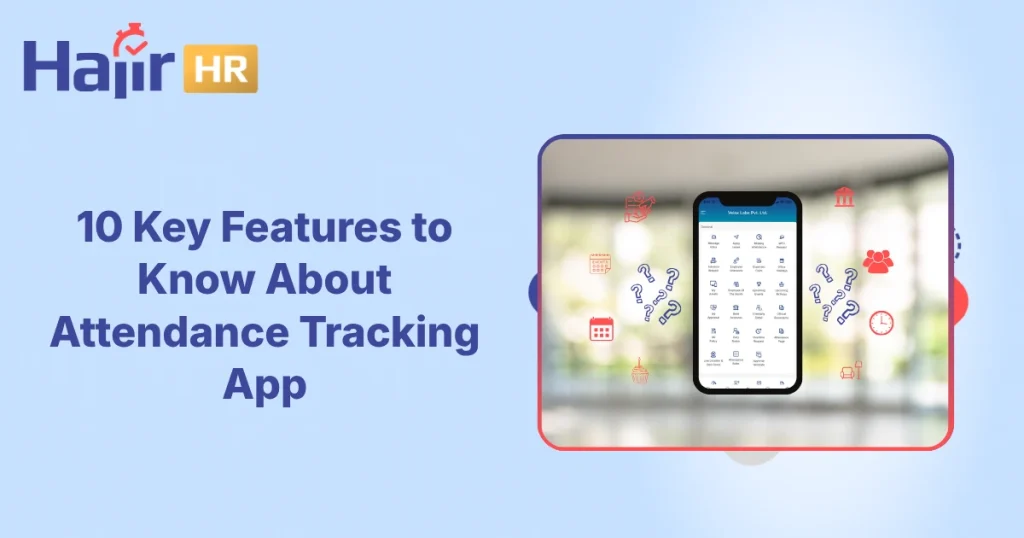
Understanding Attendance Tracking App
An attendance tracking app is more than a clock-in tracker, though. Indeed, it integrates directly with payroll, leave management and workforce analytics, providing a single point of truth for all employee time. This means HR teams can save hours per week that they would otherwise spend on manual data reconciliation.
This article discusses the key characteristics you need to seek out in an attendance monitoring application, the typical issues these systems address, and how Hajir HRM combines them all in a single application.
Why Every Business Needs an Attendance Tracking App
When compared to manual systems, an attendance tracking app does away with the guess work. In particular, it eliminates the human error in data entry, minimises time theft and provides managers with real-time insight into the people working and working when.
Moreover,attendance tracking software supports companies with the regulations associated with labour. Accurate digital records make it easier for banks to audit companies or resolve disputes while ensuring legal compliance. At the same time, the system accurately calculates employees’ working hours, overtime, and leave balances, giving staff confidence in every payroll cycle.
Plus, manual tracking is a significant constraint when teams expand. For example, there is a small business that has 50 employees that can manage attendance with ease using Spreadsheets. But the same method fails when the number of staff members equals a couple hundred from several offices.
This means that companies that invest in a reliable attendance tracking app at an early stage do not have to undergo a costly and disruptive transition later on. Instead, the system scales smoothly as it grows with them from day one.
Top Features of an Attendance Tracking App
To be useful, an attendance tracking app needs to provide a certain range of capabilities and not just be a digital punch clock. Here are the features that are most important.
Real-Time Tracking and Instant Visibility
The attendance tracking app should record the time an employee logs in and out as it occurs. If not, there will be discrepancies that can bleed over into payroll and leave calculations. This means that real-time syncing between the employee’s device and the HR dashboard isn’t a luxury; it’s essential.
Plus, instant visibility allows managers to not have to wait until end-of-day reports to know who’s in the room. Consequently, staffing shortages are identified and filled on the spot and not after the event.
Geofencing and GPS-Based Verification
A geofenced attendance tracking app sets a virtual perimeter around the work area and only allows employees to clock in when they are in the proper area. Likewise,GPS based verificationprovides accountability for field employees and remote staff who are not tasked with working in a set office.
It is a crucial feature for businesses that have delivery teams, sales reps or multi-branch operations. If this does not occur, determining the exact point of origin a user logs in from is a gambler’s game.
Biometric and Facial Recognition Integration
One of the oldest flaws in workforce management is buddy punching, which is eliminated by the attendance tracking app which supports biometric verification like fingerprint or facial recognition. Biometric data is linked to each individual so that one employee is not allowed to log in for another.
In addition, biometric software is able to shorten the entire check-in process. Employees no longer need to swipe cards or sign registers, just a few seconds and the system does the rest when they scan a fingerprint or face.
Built-In Leave Management
This is where the leave management module becomes essential; it is preferable to embed it in the same system as an attendance tracking app. Otherwise, HR has to work with two systems that don’t communicate, causing leave balance and attendance errors.
Instead, an integrated system allows workers to request leave directly in the app and managers, with a single tap, to either grant or refuse permission. In the meantime, the attendance record automatically updates, and you won’t get out of sync.
Shift Scheduling and Roster Management
For companies with several shifts, like retail, manufacturing, or healthcare, an attendance tracking app is a must-use. Specifically, it should enable HR to create rosters, schedule shifts and automatically send employees the schedule.
Besides, the system must alert someone if they are late for a shift or miss a shift without the need to call anyone. This in turn saves supervisors time in the scheduling process and allows them to focus on the actual operation.
Mobile Access and Employee Self-Service
The only way an attendance tracking app will be successful is if staff members are using it regularly. So, backend capabilities are equally important as a powerful mobile app. Employees clock in, apply for leave and access their attendance history anywhere via mobile access.
Likewise,employee self-service portalshelp HR process the number of repetitive requests he receives on a daily basis. Employees log into the app to view the leave balance, rather than seeking out HR via email.
Automated Overtime Calculation
Overtime should be automatically calculated according to company policy and shouldn’t have to be manually computed. In particular it covers overtime, working on a weekend and on a public holiday at a different rate.
This means that an automated system to calculate overtime is very helpful in eliminating payroll disputes. Employees can easily visualize how their overtime benefits their compensation, and HR can eliminate the chances of manual math errors.
Payroll System Integration
The greatest benefit of an attendance tracking app is when it integrates directly with automated payroll systems.If not, attendance information is siloed and someone needs to be manually taking hours, leave deductions and overtime and inputting them into the payroll system each cycle.
When businesses fully integrate these two systems, the software automatically calculates salaries based on attendance. This speeds up payroll processing, improves accuracy, and saves HR staff hours that would otherwise be spent reconciling numbers.
Real-Time Reports and Workforce Analytics
Using an attendance tracking app, you’ll also get useful data, not only for the number of daily clock-ins, but also information about absenteeism, punctuality and productivity by department. Reports and dashboards, therefore, should be programmable, not one-size-fits-all.
Plus, these analytics assist leadership in making informed decisions about staffing. If, for instance, a manager observes frequent Mondays off in one department, he or she may try to go straight to the source of the issue and investigate the cause, as opposed to assuming.
Smart Notifications and Alerts
When there is a need to be alerted an attendance tracking app sends smart notificationsand alerts to the proper party automatically. For example, HR receives notifications if an employee is away without permission, and employees are reminded of upcoming shifts, or pending approvals.
This allows no one to have to manually watch a dashboard for hours in order to detect issues. Rather, the system brings to light issues as they happen.
Common Challenges Attendance Tracking Apps Solve
There are a number of common challenges businesses have with paper or legacy attendance systems that are mitigated by an attendance tracking app.
Inaccurate Data Entry from Manual Punching
One of the most frequently faced mistakes is inaccuracies in data entry. In particular, manual punching, missed check-ins and human transcription errors affect payroll calculations and balances. But the risk of this is greatly reduced with automated systems.
Security Risks with Biometric and Location Data
Then there are security issues, especially as it pertains to biometric and location details. As such, businesses should look for a provider that provides data encryption and meets the requirements and standards of data protection laws.
Employee Resistance to Biometrics and GPS Tracking
There is also employee resistance which sometimes appears, particularly if biometrics and/orGPS tracking systems are perceived as invasive. However, this concern typically gets addressed over time if there is an explanation of why the system is being put in place, and how it’s beneficial to the employees in their direct work environment.
Limited Scalability as Teams Grow
Scalability is a problem when companies get bigger. Specifically, a 30 employee system may not be able to accommodate 300 employees without a major rework. Thus, the right flexible and scalable platform from the beginning will spare lots of disruptions later.
How to Choose the Right Attendance Tracking App
When selecting an attendance tracking application, it’s important to take a few crucial factors into account.
Team Size and Complexity: For small teams, you might just need clock-in functionality, whereas larger teams with multiple locations will require geofencing, biometrics, and advanced reporting.
Flexibility: Policies, overtime, and shift schedules should be flexible, not rigid; should fit your business.
Integration Capabilities: Data should integrate automatically with payroll – there is no need to manually transfer data between the systems.
Data Security:The provider should be able to provide encryption and adhere to relevant data protection laws due to the sensitivity of the data collected, such as biometric and location data.
Growth: You don’t want to be restricted to switching platforms when you hit milestones of employees.
Ready to Simplify Attendance for Your Team?
An attendance tracking app is so much more than just clock-in. Today it’s a central hub that integrates attendance, leave, payroll and workforce analytics into a single unified system. So, your HR team’s everyday workflow is directly influenced by your choice of the right one.
In the end, the ideal attendance tracking app eliminates manual tasks, addresses buddy punching, and provides HR with accurate, up-to-date data to guide decision making. With businesses moving towards hybrid and remote work, the type of system isn’t something that they can live without, it’s something that they need to have.
Book a Free Demo With Hajir HRM
Looking to make attendance tracking easy for your team? ExperienceHajir HRMtoday and discover the synergy of real-time tracking, seamless payroll integration, and intelligent automation in a single solution tailored for businesses of all sizes. Sign up for a free demo today!
FAQ:
An attendance tracking app is a software/digital solution that automatically logs an employee's clock-in and clock-out, leave, and working hours, eliminating manual attendance logging or spreadsheets.
The attendance app is essential to businesses to remove the manual mistake, avert time theft, assure adherence, and incorporate attendance information straight into payroll.
Yes, most attendance tracking applications do have mobile tracking, GPS tracking verification, and geofencing features to enable remote and field workers to clock in from anywhere with a high level of accuracy.
An attendance tracking application integrates working hours, overtime, and the deduction of leave with the payroll software and eliminates the need to enter all of this data manually, which is prone to errors when it comes to the calculations.
Yes, biometric attendance can be considered a reliable and secure way to verify attendance as long as the provider is able to provide data encryption and that they adhere to data protection laws.
Absolutely, a good attendance tracking software can handle expansion of staff, work locations, and more and more complicated attendance policies without having to migrate to a platform.
Know more about HajirHR. Your All in one HR software.
Get started now!
Recent Post