
Nepal Income Tax (TDS) on Salary: What Salaried employees pay in FY 2083/84
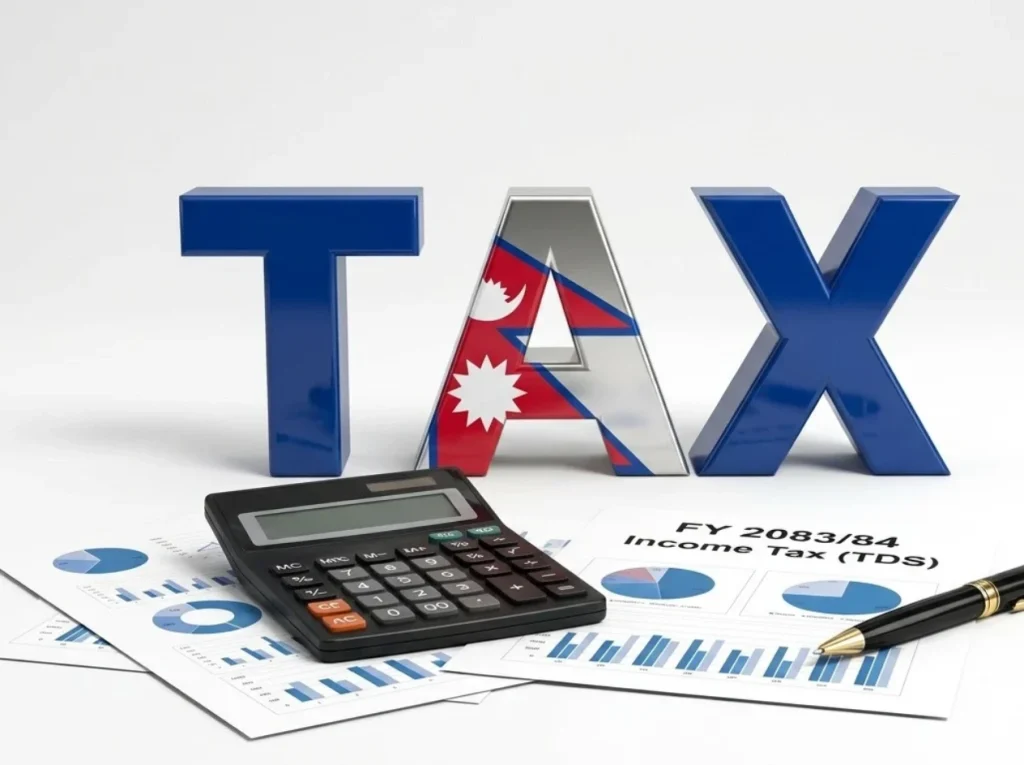
Nepal Income Tax (TDS) on Salary determines how much of your monthly salary goes into your bank account. This deduction is made from the salary of all salaried employees in Nepal, but few people bother to find out how it is calculated. The government has overhauled the fiscal 2083/84 slabs, and it is pretty huge. The bottom tax slab has been increased to Rs 10 lakh and the top rate reduced to 29 per cent. This translates into a smaller percentage deducted from their paychecks each month, and a healthier paycheck for most workers.
Fast Onboarding
Secure Cloud-Based
Employee Self-Service
Monthly TDS: annual tax ÷ 12
Tax slabs: 1%–29%
SSF, CIT cut taxable pay
Deposit by the 25th
The employers are still responsible to withhold tax correctly and pay it to the Inland Revenue Department. The employees, however, should be knowledgeable enough to check all their payslips. If one of the assumptions is wrong by a small margin, then you might be deducted too much or you may be left with an unexpected tax bill later. This article gives a description of the existing slabs, taxable portion of your salary and the monthly calculation method. It also illustrates how the complete process can be automated by payroll software like Hajir HR. If you are an employee,HR Officer or business owner, the information below will help you.
How TDS on Salary In Nepal works
TDS is the acronym for Tax Deducted at Source. Your employer calculates your taxable income for the year at the beginning of the year. The tax for that amount is then apportioned among the twelve months. That amount will be deducted from your paycheck and sent to the tax office each month. If your pay is altered in the middle of the year due to a raise or bonus, the remaining months are recalculated. This will keep the final annual deduction near your true tax liability.
Nepal Income Tax Slabs for FY 2083/84
Now, there is a single schedule adopted for resident individuals. The distinction between the single taxpayer and married taxpayer is no longer applicable. The following table provides the summary of the current rates of income tax in Nepal.
Annual Taxable Income (Rs) is calculated using the tax rate.
Up to 10,00,000 | 1% |
10,00,001 – 15,00,000 | 10% |
15,00,001 – 25,00,000 | 20% |
25,00,001 – 40,00,000 | 27% |
Above 40,00,000 | 29% |
If the employee contributes to theSocial Security Fund, he or she might not be taxed on the first slab. Please check your eligibility with your employer or tax advisor as the rules are subject to change as a result of Official circulars.
What Counts as Taxable Salary
Gross pay is not subject to tax. Taxable income comprises basic salary, allowances, bonuses and most other benefits received from the employer. This is then less the approved deductions. Such contributions typically are those to SSF, Citizen Investment Trust or provident funds, and to premiums of eligible insurance. Such deductions will be made only within the limits of the law. Finally, you get your annual income that is taxable, on which the slabs are applied.
Worked examples on calculating salary taxes in Nepal
Let’s take an example of an employee whose taxable income is Rs 12,00,000 per year. The first Rs 10,00,000 attracts Rs 10,000 at 1 percent. The remaining Rs 2,00,000 attracts Rs 20,000 at 10 percent. The annual tax is Rs 30,000 and hence monthly TDS is approximately Rs 2,500.
Now, if he has an annual salary of Rs. 20,00,000, which is taxable. The first slab provides Rs 10,000 and the second slab provides Rs 50,000. The final Rs 5,00,000 is taxed at 20 percent, which adds Rs 1,00,000. Total tax is Rs 1,60,000, or roughly Rs 13,333 each month.
If any employee has an income of Rs 6,00,000/year, then he remains in the first slab. The person pays Rs 6,000 per year or Rs 500 per month, without any exemptions.
How TDS Is Calculated in Hajir HR
A few members of staff can use manual calculation. When bonuses, leave deductions and allowances vary from month to month it can become tedious. This is whereHajir HR payrollcomes in handy for organizations in Nepal.
Hajir real-time payroll calculation of attendance, overtime, bonuses, loans, advances, insurance and taxes including SSF, CIT and TDS. Salaries are calculated either by the day worked or by the day of the week, as specified in the company’s policy. When the monthly salary is made available, thesalary TDS is automatically calculated. Specific settings will vary depending on how your business sets up its compensation system.
Admins also receive reports that are easier on the eyes. The TDS projection report displays the distribution of the annual tax liability in the months. The tax calculation detail provides details on how each employee’s figure is calculated. Payroll report missing indicates who was not included in a run. Another time-saving advantage for Hajir is the support for bank, SSF, CIT and TDS letters.
Consequently, HR teams waste less time on spreadsheets and are less prone to mistakes. Always verify that slabs for any tool are in line with the most recent Finance Act.
Employer Responsibilities for Deposit of TDS.
Withheld tax must be paid to the Inland Revenue Department in accordance with the time limits. The general rule is that the deadline is the 25th of the next Nepali month. They should also provide tax records to the employees and have payroll records to review for audit. Payments that are late can incur interest and penalties, so it is best to set up a monthly schedule
Common mistakes in Salary TDS
The most common error is to consider gross pay as taxable income. The other one is not accepting bonuses until the end of the year, resulting in a massive cut in the last few months of the year. Old slabs are continued to be used by some teams after the start of a new fiscal year. Others do not update deductions when an employee joins SSF and/or when they purchase insurance. By checking payroll settings every Shrawan, most of these problems can be avoided.
Social Security Fund (SSF) in Nepal: Contribution Rates, Employer Duties and Tax Benefits
The amount that you contribute to the SSF will affect your pay and your taxable income. Our next item of discussion is how the fund works, who is required to enroll, and the impact it will have on monthly deductions.
Frequently Asked Questions (FAQ)
TDS on salary is income tax which is deducted by the employer from the monthly salary that you receive. The employer then submits it to the Inland Revenue Department for you.
The slabs are such that 1 percent will cover up to Rs 10 lakh, 10 percent up to Rs 15 lakh and 20 percent up to Rs 25 lakh. The income up to Rs 40 lakh is taxed at 27 per cent while the income above Rs 40 lakh is taxed at 29 per cent.
Your employer calculates your taxable income for the year, taxes it at the slab rates and then divides by 12. Later months may be adjusted due to changes in pay during the year.
No. Resident individuals are treated in the same way as the separate treatment for single and married taxpayers has been eliminated and one schedule is used for all resident individuals.
Yes. Hajir HR takes attendance and other data andcalculates payroll, computes salary TDS and provides TDS projection and tax detail reports.
Begin with your HR/payroll department and compare the payslip to your annual taxable income. If the problem does not resolve, see a tax specialist or the Inland Revenue Department.
Trusted by 1600+ Organisations
Why to Choose Hajir?
Efficiently manage payroll, leave, and communication to streamline
HR processes and enhance employee satisfaction.
HR processes and enhance employee satisfaction.
Cost Effective Solution
Automates manual processes, saving businesses on administrative costs and resources.
Cloud-Based Accessibility
Access your data anytime, anywhere—perfect for remote and hybrid work environments.
Customizable Features
Adaptable to your business needs, with features like shift scheduling, WPS compliance, and custom reporting.
User-Friendly Interface
Designed for simplicity, ensuring a smooth experience for both HR teams and employees.
Data Security & Compliance
Robust security measures protect sensitive employee information, meeting regional compliance standards.
Quick Implementation
Hassle-free setup and onboarding process that gets your HR operations up and running in no time.
Scalability
Whether for small businesses or large enterprises, it can scale to meet the needs of any organization.
Boost Employee Productivity
With automated processes and real-time updates, Hajir helps you focus on what matters most—growing your business
12h/6d Customer Support
Dedicated support ensures that your HR operations run without a hitch.
Download the App and Get Started
Get the app from Play Store and App Store