Employee Overtime Tracking Software That Tracks Hours Automatically | Hajir HRM
Overtime tracking software enables companies to efficiently and accurately keep track of overtime hours. Manual timesheets have been a challenge for businesses in all industries, and there are chances of payroll disputes when they are inaccurate. As a result, more and more organizations are seeking the help of digital tools that will automatically track overtime.
Employee overtime tracking software matters for a clear reason: it simplifies compliance, cuts payroll errors, and strengthens workforce management overall.
Fast Onboarding
Secure Cloud-Based
Employee Self-Service

What Is Employee Overtime Tracking Software?
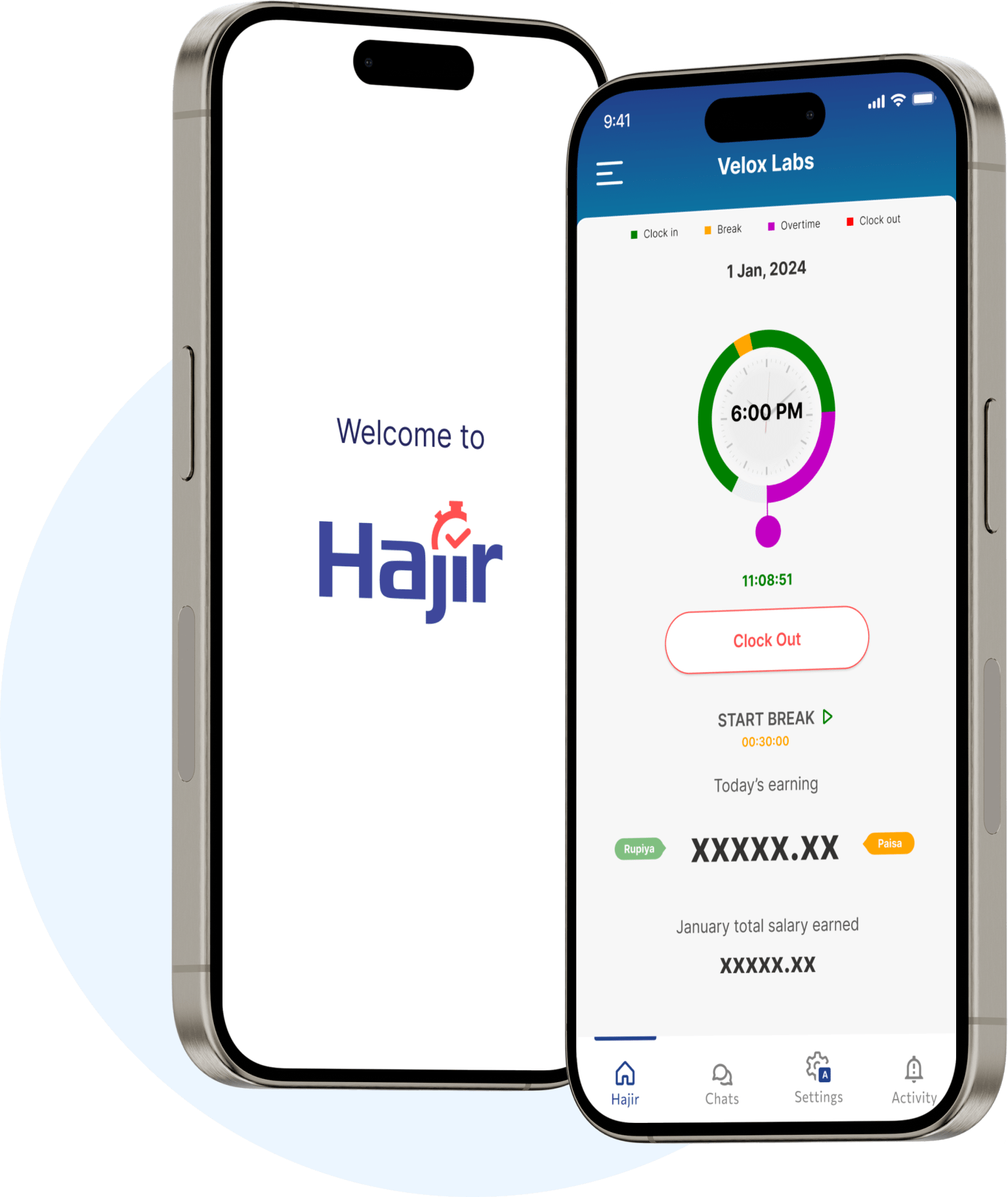
Overtime tracking software for employees keepstrack of employee overtime.Automatically collects clock-in and clock-out times, computes overtime hours, and automatically enforces overtime rules.
How the System Works
Most platforms are able to connect seamlessly with payroll platforms. This means that overtime hours will be automatically calculated and applied without having to enter them manually. This link means that there is a lower chance of human error and less administrative time spent.
Employee overtime tracking software also securely records employee overtime history. As a result, companies can easily get access to previous timesheets at any time when audits, disputes orperformance reviewscall for documentation.
Key Capabilities to Expect From Overtime Tracking Software
A good platform will have:
- Real-time dashboards that alert employees before they hit their overtime thresholds and costs escalate.
- Mobile apps that enable staff to clock in anywhere, such as job sites and remote offices are one example.
- Flexible rules for weekend, holiday or shift pay rates to reflect company policy
- Self-service portalfor staff to check hours logged against themselves and not contact HR
- Automatic Timestamp locking to prevent unwanted changes to information after a shift is closed.
- Thegeofencing attendance capabilities that verify that employees clock-in from authorized sites.
Why Businesses Need Employee Overtime Tracking Software
Manual processes can pose compliance issues for companies. Overtime pay regulations differ by state and country and penalties for overtime pay violations are expensive.
Compliance and Cost Control
Employee overtime tracking software automatically calculates overtime according to the rules, minimizing legal risk. Overtime information can also be more accurate and up-to-date, allowing finance teams to do more accurate forecasting.
Businesses that don’t have this visibility can often end up with unexpected payroll budget overruns and underestimate the cost. Manual tracking, on the other hand, consumes significant HR time in reconciling time sheets and fixing errors.
Key Features to Look For in Employee Overtime Tracking Software
All platforms do not have the same features. Businesses need to carefully consider features that impact their day-to-day activities before selecting a solution.
Automated Employee Overtime Tracking Software Alerts
Overtime alerts are sent automatically to managers when an employee approaches overtime limits. This characteristic allows supervisors to make adjustments to the schedule in advance, rather than in response to rising costs.
Certain systems can include department/user specific alert thresholds. Likewise, firms may have various regulations for their full-time workers as compared to their contractors.
Reporting Tools Within Employee Overtime Tracking Software
Leaders have detailed reporting tools to see what is happening with the labour market. Overtime reports are generally segmented by department, employee or time period, allowing managers to spot trends early on.
Exportable reports also make audits easy. Businesses have the ability to quickly provide accurate records when regulators request such documentation, whereas without the ability to quickly and easily gather these records, businesses are required to sift through a mix of scattered records.
Benefits of Using Overtime Tracking Tools
A dedicated system has tangible benefits throughout the organization.
Fewer Payroll Errors
As soon as manual data entry is removed from the process, accuracy improves witherror free payroll.This means that workers are paid rightly without any errors during each pay period.
Easier Compliance
Providers automatically update systems to reflect any changes in labor rules. As a result, businesses do not have to assign additional time to their staff for keeping abreast of the law.
Higher Productivity
HR and finance professionals free up their time for strategic tasks as opposed to repetitive calculations. As a result, teams are more efficient without extra people.
Better Decision-Making
Overtime trends can be examined at a monthly or yearly level to inform staffing decisions. This transparency ensures that you don’t have any budget surprises to deal with.
Stronger Trust
Staff can see their own hours, minimising disputes and boosting confidence in the workplace. This transparency provides for a stronger partnership between staff and management over time.
Effortless Scalability
The software can manage hundreds of otheremployee records without any additional administrative hassle. Meanwhile, faster payroll cycles means runs complete earlier, particularly during busy times.
Companies that measure the benefits over the long-term are likely to see the software return their investment in no time at all due to just saved man-hours and fewer errors.
How to Choose the Right Software
Before buying a platform, there are a few factors to consider.
Check Integration
The tool should seamlessly integrate with existing payroll, scheduling, and HR systems. Otherwise, companies run the risk of building new data silos rather than addressing existing issues.
Compare Pricing Structure
Be sure to carefully consider per-employee versus flat-rate plans, as costs can add up rapidly over time as the number of employees increases. It might be an affordable plan to start, but as the team grows it can start to cost more.
Confirm Customer Support
Ensure response times and support are guaranteed as payroll deadlines are tight when there are technical problems. During stressful times, responsive support is essential.
Verify Security
Confirm the security protocols and certifications, given that these platforms handle sensitive employee information that needs robust security measures. Trust can be damaged in a blink of an eye when there is a breach of payroll data.
Common Mistakes to Avoid
Failure to launch a new system is a common mistake that many businesses make:
- Rushing the selection process, which often leads to tools that lack essential features
- Skipping employee training, which causes staff to fall back on old manual habits
- Ignoring mobile accessibility, which hurts accuracy for field and remote workers
- Choosing based on price alone, which sacrifices functionality like reporting or mobile access
- Never reviewing reports, which wastes the insight the software generates
- Overlooking employee feedback, which slows adoption across the organization
- Failing to set a rollout timeline, which allows the transition to drag on indefinitely
Final Thoughts
An overtime tracking for employees also ensures the business remains secure for future growth and changing rules. Companies avoid the need to correct payroll errors after they are made, and instead learn how to prevent them from occurring in the first place.
Those companies that are quickest to adjust usually have the greatest benefit, as when payroll is accurate, staff stay and profits increase.
Simplify Overtime Management with Hajir HRM
Looking to cut payroll troubles and to get complete management of employee hours? Built specifically for growing teams, Hajir HRM allows for automated overtime tracking, real-time alerts and seamless payroll integration.
Get a free demo of Hajir HRM today and discover for yourself how easy it can be to manage your workforce.
Trusted by 1600+ Organisations
Why to Choose Hajir?
HR processes and enhance employee satisfaction.
Cost Effective Solution
Cloud-Based Accessibility
Customizable Features
User-Friendly Interface
Data Security & Compliance
Quick Implementation
Scalability
Boost Employee Productivity
12h/6d Customer Support
Download the App and Get Started