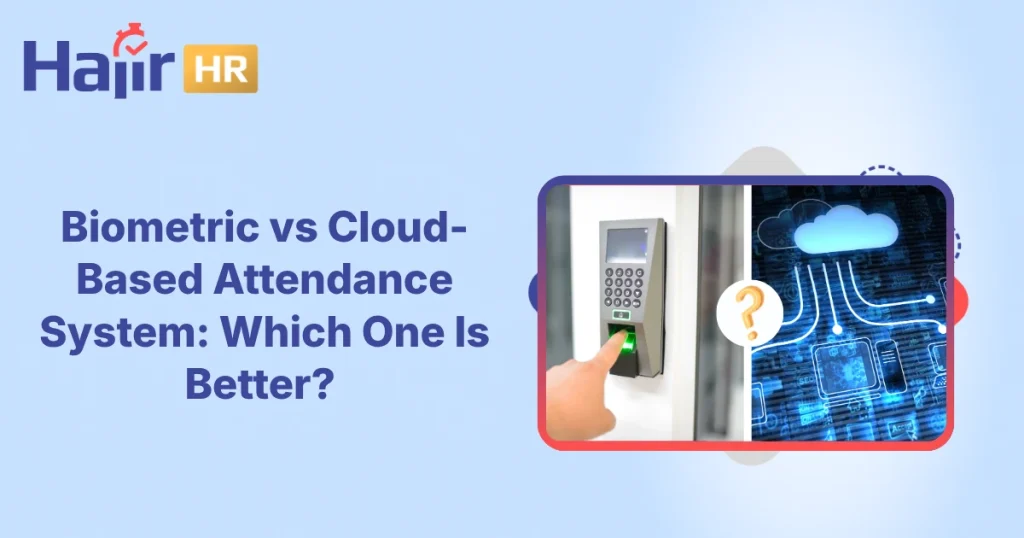
Biometric vs Cloud-Based Attendance System: Which One Is Better?
At some point, all HR teams end up asking themselves, “Do we need to use hardware to monitor attendance or should it be in the cloud? It’s a battle that has been raging in most modern workplaces: biometric attendance vs cloud-based attendance and the correct response is contingent on the way your workforce functions.
Thus, this guide explains both systems simply. You will discover how each of them works, which one is best for each use and what to look for in your organization. Let’s do it then.
What is a Biometric Attendance System?
Biometric attendance system uses physical characteristics to identify a person. Biometric markers can include fingerprints, facial scans, and iris patterns. Thus, this data is stored initially and subsequently compared with a current scan when an employee logs in.
Therefore, this approach greatly hinders what’s known as “buddy punching”. The machine is not a card or PIN reader, so one employee cannot clock in for the other. Also, the hardware is on site, so the device employs attendance logs (unless it connects to another system).
Understanding Cloud-Based Attendance System
Acloud-based attendance system, on the other hand, saves and keeps attendance data on remote servers and not on local equipment. Attendance is recorded by employees via a mobile app, web browser or connected device and it is immediately synced to the cloud.
This configuration makes it easy for managers to access reports from any location. Also, the system can be integrated with GPS tracking and geofencing, allowing it to verify an employee’s location for check-in. This is a significant point when working on a distributed or remote team, as everyone doesn’t need to be at one specific place.
Biometric vs Cloud-Based Attendance System: Core Differences
Now that you understand both terms, let’s compare them directly. The table below breaks thebiometric vs cloud-based attendance system comparison into the categories that matter most to HR teams.
Factor | Biometric System | Cloud-Based System |
Identity check | Physical trait (fingerprint, face, iris) | Login credentials, GPS, or selfie check-in |
Data storage | Local device or on-site server | Remote cloud servers |
Remote access | Limited or none | Full access from anywhere |
Setup cost | Higher (hardware required) | Lower (software subscription) |
Maintenance | Regular hardware upkeep | Vendor-managed updates |
Best fit | On-site teams, factories, secure facilities | Remote, hybrid, or multi-location teams |
Why This Comparison Matters for Growing Teams
Fast team building companies do not remain in the same office indefinitely. So, if you are looking to increase the number of workers in your organization, or introduce hybrid working, you need an attendance system that will grow with you. Otherwise you will have to move data and train employees again within the year or two.
Key Advantages of Biometric Attendance Systems
There are many benefits of biometric attendance systems, especially for companies that require stringent identity management. Now, let’s take a closer look at the benefits that are most important.
1. Stronger Fraud Prevention
Through biometric verification, proxy attendance is reduced to near zero. The system verifies a physical characteristic; thus, no one can swipe a card or log on to someone else’s account. So attendance and payroll are kept accurate and records remain honest.
2. Tighter Workplace Security
Properly encrypted and stored, biometric data provides an extra level of physical security that badges and PINs do not. Badges get lost. PINs get shared. Fingerprints don’t. For this reason, numerous factories, laboratories and secure facilities have biometric checkpoints as a minimum standard.
3. Precise Time Tracking
Biometric devices automatically and accurately record check-in and check-out times. This means that HR teams waste less time worrying about discrepancies andpayroll processing time is improved because the numbers are already correct.
Key Advantages of Cloud-Based Attendance Systems
On the other hand, cloud-based systems address other issues, particularly in terms of flexibility and accessibility. Here they are ahead of us.
Anywhere, Anytime Access
Cloud-based attendance enables workers to clock in from anywhere on their mobile device – a phone, laptop or tablet. So this means remote employees, field workers and travelling sales people are covered by the same system.
Lower Upfront Investment
Cloud Software is not hardware based, but instead has to do with a subscription. Therefore, companies do not have to spend on scanners, installation, or maintenance of devices. Rather, the vendor takes care of the backend part of the infrastructure and its updates.
Real-Time Reporting
Managers can generate attendance reportsas they need, as data is synced continuously. Plus, it integrates with payroll and HR systems, reducing manual exports and minimizing potential downstream mistakes.
Biometric Attendance System vs. Cloud-Based Attendance System, which suits your business?
So you may still be asking yourself, which one is right for your business? Well, it really depends on your staff composition, as opposed to the fancier the technology sounds the better.
For Office-First or Factory Teams
Those who have most of your employees working from a single location, a Biometric Attendance System might be more appropriate. For example, identity checks are integrated and records are tamper-proof in manufacturing floors, warehouses and secure facilities. Furthermore, biometric systems are effective in areas where badge sharing or buddy punching has been an issue in the past.
Available to Remote, Hybrid or Multi-Location Teams
If your team has multiple locations, across timezones or home offices, then a cloud-based attendance system fits the bill. Employees can log in from any device – you don’t have to force workers to work around. Plus, GPS-based verification still verifies location, meaning no loss of accountability due to dropped hardware.
The Hybrid Reality Most Companies Land On
Modern HRMS systems will, in practice, combine both methods. On-site verification is managed by biometric devices and the data is managed by a cloud dashboard which can generate reports and link to payroll. Hajir HRM is built this way; you can connect your existingbiometric devicesstraight into the platform, so fingerprint or face-scan check-ins flow into the same cloud dashboard used for remote and hybrid staff. No separate systems, no manual reconciliation.
Industry-Specific Use Cases
Each industry has a preference for solutions, in part due to the fact that the composition of their workforce can vary greatly. Let’s examine a couple of examples to make this point clear.
Manufacturing and Warehousing
Manufacturing floors operate on shift schedules, require tight security and are highly staffed at a single location. Thus, biometric attendance systems are well suited, as they eliminate buddy punching for huge rotations of shifts and integrate seamlessly with safety compliance systems. Plus, many factories already have biometric access control in restricted areas—expanding to attendance control adds little overhead to the system.
IT, Consulting, and Remote-First Companies
Large IT companies and consulting firms typically have teams that are spread out across cities or countries. Therefore, it is much more logical here to use a cloud-based attendance system, because employees do not work in the same office.
Additionally, businesses can tie project-based billing directly to accurate time tracking. When attendance data syncs automatically with payroll or billing systems, teams save hours of reconciliation work every month.
Retail, Hospitality, and Field Services
Often retail and hospitality operations use a mix of both systems together. Store personnel register biometrically at a specified location; delivery drivers, field technicians or travelling sales representatives register themselves via GPS-based attendance system.In doing so, this hybrid solution provides management with complete visibility of all employees, irrespective of their physical location.
How to Choose the Right Attendance System
It is not difficult to settle on which of these two options you would like to have. Use the following checklist to get to the point of narrowing in fast.
- The first step is to chart out the number of employees working remotely as compared to those working on site.
- Then, determine the amount of money that you can realistically spend on hardware versus subscription.
- Next, see if your existingpayroll software can work with either of the options.
- Then verify industry standards for meeting requirements with respect to biometric data.
- Lastly, test one team of the system before implementing it across the company.
While working through the list, you’ll end up on a decision that’s based on your actual operations and not just on the claims of the marketing.
Final Thoughts on Biometric vs Cloud-Based Attendance System
The problem of biometric attendance systems vs cloud-based attendance systems isn’t truly a matter of choosing between one or the other. It’s not about pairing the right tool with the right team, it’s about pairing the right team with the right tool.
Biometric systems provide 100% certainty of identity verification at the point of use. Cloud-based systems provide flexibility, remote access and reduced upfront expenses. Thus, numerous business organizations find themselves utilizing both, one combined HR platform.
For those interested in the role of the modern attendance tracking system in the bigger picture of human resource management, then you can find all information regarding attendance, leave and payroll in one place – Hajir HRM. You can use the site to explore and find out how it will fit your team.
Book a Free Demo with Hajir HRM Today
Book a FREE Demo withHajir HRM today and discover the benefits of biometric and cloud-based attendance management—all in one powerful HRM solution.
FAQ:
Both of these choices are not always the right one. On-site teams that require strict identity verification benefit from biometric systems, while remote or hybrid teams reap the benefits from flexible, anywhere access from a cloud-based system.
Yes, a company can implement both biometric and cloud-based attendance systems at the same time. On-site check-ins are done with the biometric devices, and the data is stored in the cloud, reported and synced to payroll.
When the vendor securely encrypts biometric information and maintains clear policy and consent procedures, the data remains secure. Before implementing any biometric system, be sure to verify these points.
Most of the cloud-based systems require an Internet connection to make the data sync in real time. Some platforms, however, support offline check-in that synchronizes with the back-ends when connection is restored.
Yes, cloud-based systems work well for remote and field workers as check-ins are made via a mobile app or browser, typically with GPS verification.
Cloud systems typically have lower initial costs, as they do not require hardware investment. Biometric systems, on the other hand, require a higher investment upfront but have the potential to save losses related to fraud in the long-term.
Know more about HajirHR. Your All in one HR software.
Get started now!
Recent Post