If you are using Hajir V1 Kindly visit here for admin login.

OKRs vs. KPIs: Which Drives Better Results?
OKRs (Objectives and Key Results) and KPIs (Key Performance Indicators) are the two popular frameworks that dominate the goal-setting conversation. Even though the two are trying to improve concentration, accountability and performance, their differences are on the purposes and uses. The purpose of the OKRs is to motivate the teams to go beyond the usual performance and to focus them on the exalted goals. KPIs on the other hand keep track of continuous operational performance using certain metrics. To have significant outcomes it is crucial to know what the difference is and when to apply each of them.

What Are OKRs?
OKRs (Objectives and Key Results) are a goal-setting system that helps teams focus on achieving clear and measurable results. They are composed of an explicit, qualitative objective of what you would like to accomplish and results that can be quantifiable and specific. used to measure progress towards the goal. This approach helps teams set goals but remain grounded in the data-driven outcomes.
For example, your aim is to improve the team’s engagement via remote then your goal would be only that. The most important results could be steps like arranging three virtual team-building activities and establishing a weekly check-in meeting to ensure everyone is connected and obtaining feedback from employees via HajirHR surveys. The following actions will help monitor the advancement of the team and keep it on course towards enhanced engagement.
What Are KPIs?
KPIs (Key Performance Indicators) are quantifiable numbers that allow organizations to track the performance of their business over time. They are a clear way to measure how certain processes or tasks are performing. The most common examples are monthly sales revenue as well as the rate of customer churn as well as the conversion rate for websites and the rate of employee turnover. These indicators provide teams with an overview of their performance and assist in identifying areas that need to be addressed.
Unlike OKRs, which focus on ambitious goals, KPIs are more stable and usually reflect past or present performance. They help to determine the extent to which a company can meet its normal requirements for business and ensure the health of its operations. By closely monitoring KPIs, businesses can stay consistent, make informed decisions, and address problems before they escalate.
OKRs vs KPIs: The Core Differences
While businesses regularly use both OKRs and KPIs to measure progress, understanding the key differences between them is essential. With OKRs, you define big, strategic goals that drive progress, while KPIs monitor day-to-day performance, ensuring things stay on track. When used together, they give a full picture of growth and efficiency.
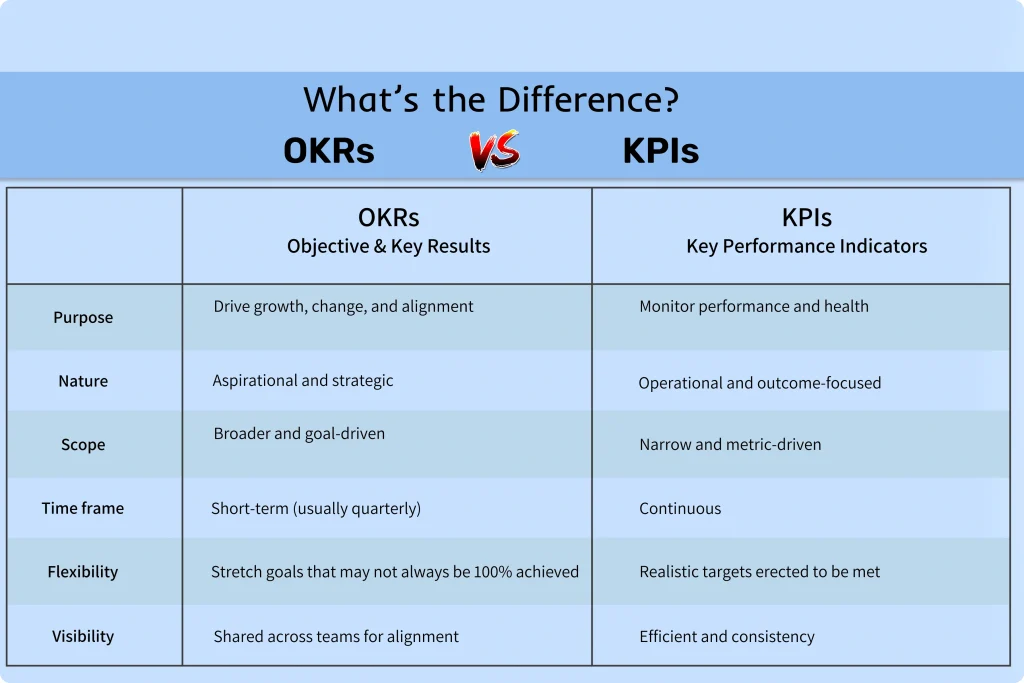
OKRs vs KPIs: Which One Drives Better Results?
The answer will depend on your goals for business as well as your growth stage and your culture. In most cases, the true strength lies in the combination of these together.
Use of KPIs:
- Track baseline performance.
- Check on the ongoing operation.
- The team members are expected to be responsible to the same results.
Use of OKRs:
- Set ambitious goals.
- Cross-functional teams should be aligned.
- Encourage growth and innovation.
For Example:
Imagine a business using HajirHR, an intelligent HRMS system designed specifically to work with teams from all over the world. Their KPI could be to keep the turnover of employees below five percent, thereby assessing how effective they keep staff. While doing this they are implementing their OKR is focused on increasing the retention of employees across offices and key outcomes include the implementation of HajirHR’s onboarding processes for all teams as well as launching quarterly performance reviews on the platform, and boosting employee engagement scores. Through combining the constant evaluation of KPIs and the enthralling and action-oriented approach of OKRs they can achieve significant, tangible gains in retention.
How HajirHR Helps You Manage OKRs and KPIs?
The management of goals and performance across many groups and different time zones is not an easy job. This is where HajirHR tools can help;
- Monitor KPIs such as time, attendance, task completion and leave trends.
- Create up and coordinate OKRs across departments.
- Conduct reviews of performance using built-in analytics.
- Real-time team visibility is possible for members and HR.
The mobile-first platform enables global teams to remain aligned, accountable, motivated, and focused regardless of the location they are.
Common Mistakes to Avoid
In the case of KPIs and OKRs Here are a few dangers to be aware of:
- Utilizing too many metrics.
- Setting vague objectives.
- Tracking but isn’t performing.
- Separate goals.
- Neglecting cultural fit.
Conclusion : OKRs vs KPIs?
So, which is the one that produces better results: KPIs or OKRs?
- If you’re looking for creativity, transformation, alignment, and change, the OKRs win.
- If you want consistency and accountability, then KPIs are vital.
If you want to sustain success, you’ll require both. OKRs establish the goal. KPIs help track the journey. With HajirHR it is possible to set specific goals, monitor results in real-time and ensure that the whole team from HR to leadership is in sync and heading in the correct direction.
Recent Post