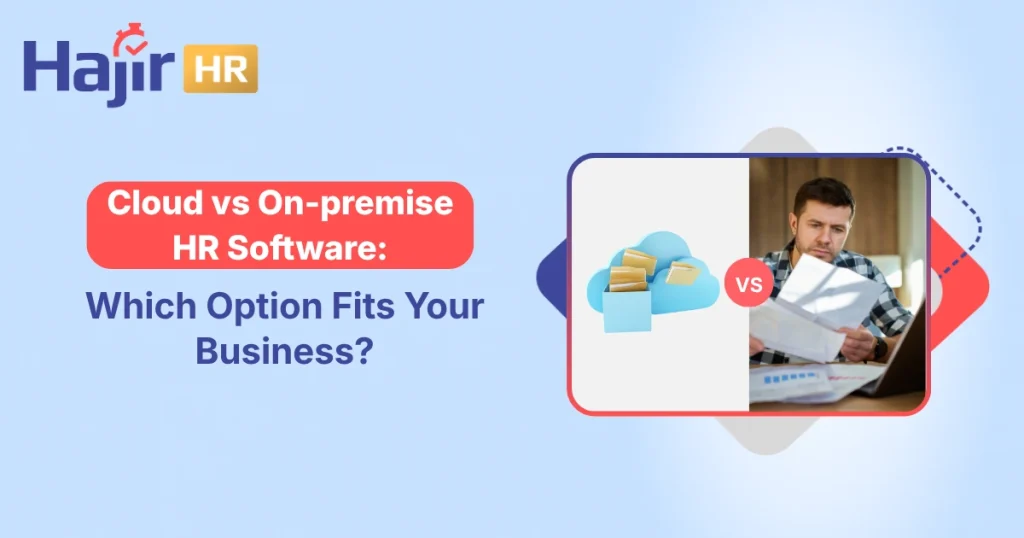
Cloud vs On-premise HR Software: Which Option Fits Your Business?
One of the major decisions HR leaders must make today is between cloud and on-premise HR software. Indeed, any expanding company at some time surpasses spreadsheets and obsolete systems. This makes selecting the best deployment model a strategic priority, rather than an IT chore.
Both of these are explained in this guide. This means that you can evaluate the costs, security, scalability, and deployment time of each one side by side, allowing you to make the best decision.
Moreover, HR technology has a major role to play in payroll, compliance, and everyday employee processes. Therefore, this resolution is of a lot more importance than any other business software.
What Is Cloud HR Software?
Cloud HR Software is deployed on servers located at a vendor’s remote site and managed by the vendor. So, employees can log in to the platform from any location via a browser or mobile app.
Usually, this model is subscription-based. This ensures that there are no high upfront costs and only monthly or annual charges.
Key Features of Cloud HR Software
- Subscription pricing, not upfront.
- The auto-update and security patch feature is not available.
- Connect from any device with an internet connection!
- Scalable and expandable for future growth.
Benefits of Cloud HR Software
- Rapid deployment (sometimes within days)
- Reduce IT maintenance workload.
- Easy-to-use for remote and hybrid teams.
- Anticipating monthly/yearly expenditures and budgets.
What Is On-premise HR Software?
On-premise HR Software is installed on business servers. The organization should handle any maintenance, updates, and backups, however.
This is usually a costly up-front investment in hardware and licensing. Still, some companies opt for it for the extra control that it offers.
Key Features of On-premise HR Software
- The one-time purchase of Licensed infrastructure.
- Data stored in the company network only during the entire process.
- Perform manual updates and patch management.
- Complete in-house control of customization.
Benefits of On-premise HR Software
- A full range of data control for regulated industries.
- No reliance on third party uptime service.
- Compliance workflows that are tailored to complex compliance requirements
- Cost model based on one-off expenses in the long term.
Cloud vs On-premise HR Software: Key Differences
There are different key aspects where Cloud HR software and on-premise HR software differ. Both models have varying deployment speeds, costs, ease of access and scalability.
Cost Comparison
Thepricing models are very different between Cloud and on-premise HR software. Cloud platforms involve on-going costs, whereas on-premise systems involve up-front costs.
- Cloud: Predictable subscription fee, low cost upfront
- On-premise: Large initial cost of hardware and software licenses
- Cloud: Maintenance in the cloud.
- On premise: Continuing IT staffing costs, hardware refresh costs
Security and Compliance
The cloud vs on-premise HR software debate is often skirmished by security issues, particularly in industries that are involved in the handling of employee sensitive information. Both models may be safe, but the responsibility lies with different people.
- Cloud: Vendor-managed enterprise grade encryption and audits
- On-premise: Comprehensive on-site security management
- Cloud: Best for businesses without a cybersecurity team.
- On-premise: Best suited for regulated industries that require data localization.
Scalability and Flexibility
The difference between the two models is clearly apparent in the word scalability.Cloud Systems dynamically adjust to growth, on-premise systems require extra hardware to meet it.
- Cloud: Scales automatically as number of users increases
- On-premise: Needs extra equipment for extension
- Cloud: Naturally enables work from anywhere and hybrid teams.
- On-premise: It is more appropriate for stable and predictable teams.
Implementation Time
Another area that makes it clear that cloud vs on-premise HR software has a speed difference is implementation speed. Cloud deployments take place fast while on-premise deployments take a lot longer.
- Cloud: Live within days/weeks.
- On-premise: Can take months to be set up thoroughly.
- Cloud: Limited internal IT involvement needed
- On-premise: Needs onsite IT support during implementation
Real-World Use Cases
The decision between cloud and on-premise HR software may ultimately be determined by the size of the business, industry, and organizational setup of the company. But in some cases one model is obviously better than another.
When Cloud HR Software Makes Sense
- For startups and small businesses that have a small IT team.
- Companies that have remote orhybrid staff.
- Businesses that anticipate a quick growth in the number of employees
- Businesses that need quick deployment, with minimal set up.
When On-premise HR Software Makes Sense
- Government agencies with data localization laws that they must adhere to
- Large companies that have their own IT and security staff.
- Strictly regulated sectors such as defence or banking
- Existing facilities investment organizations
Hybrid HR Software Approach
Interestingly, some organizations don’t stick to just one model but instead pursue a hybrid approach. Here, the sensitive data remains on-premise and everyday HR processes take place in the cloud.
- Featuring control and flexibility for larger businesses
- Relieves the transition journey to full cloud adoption.
- Works well for companies on the middle of the compliance migration journey
- Needs attention to integration issues between both systems
How to Choose the Right HR Software
Choosing the right HR software, cloud or on-premise, should fit your budget, compliance requirements and growth goals. Before you make your decision, consider these factors logically:
- Resources: Cloud has lower upfront costs, on-premise involves capital investment.
- Cloud suits businesses, which have no IT teams.Cloud suits businesses that have no IT teams.
- Compliance: On premise control may be required for regulated industries.
- Cloud flexibility is ideal for fast-scaling businesses, especially when it comes to growth plans.
- Network: The workforce should have access to the network from anywhere – cloud-based is essential for remote teams.
- Data sensitivity: If the data being stored is very sensitive, then on-premise control might be preferred.
- Long-term strategy: Think about where your business will be in 5 years time.
Also ask vendors on both sides to give demos. This means you can test out the real-world usability without making any commitments, and include finance, IT, and HR partners early in the process.
Industry Trends in HR Technology
The HR tech market continues to evolve towards a “cloud first” approach. Organizations in every sector are moving from legacy infrastructure to more modern solutions, and this is increasingly the case.
- Payroll and Analytics powered by AI fit seamlessly into cloud platforms.
- Nowadays, remote or hybrid work revolves around tools that enable anywhere access.
- Cloud adoption is still continuing to grow faster than on-premise investment every year
- On-premise systems are still used in Government, Financial and other industries for compliance.
This does not imply that on-premise systems are going away, though. There are still industries that are regulated that need to have strict data localization, and in this case, on-premise HR software is not irrelevant.
Cloud vs On-premise HR Software: Final Verdict
So, which is the winner between cloud vs on-premise HR software? In conclusion, cloud solutions are better for small and mid-sized businesses. At the same time, enterprises with high-regulatory requirements, such as large enterprises, may still need on-premise systems.
However, the market is clearly on the cloud trend! As remote working and cost-efficiency remain key drivers of demand, most modern HR platforms are now cloud first.
Hajir HRM: The Smarter Cloud HR Software Choice
If you’re on the fence about cloud vs on-premise HR software, Hajir HRM provides you with a modern, cloud-based HR solution for growing businesses. Unlike traditional on-premise solutions, Hajir HRM does not require a large investment in hardware and can be activated in days.
- Automatic updates & enterprise-level security.
- Effortless scaling with expansion.
- Anywhere access for remote/hybrid staff
- Clear and understandable subscription costs.
Simplify Your HR Today withHajir HRM Ready to move beyond outdated systems? Schedule your free demo with Hajir HRM today and experience effortless cloud-based HR software.
FAQ:
Cloud HR software is hosted on vendor servers and only requires Internet connection. On-premise HR software is installed on a business's own servers and needs to be maintained in-house.
Generally, yes. Subscription pricing is used for cloud platforms, as it eliminates large upfront capital expenses. If you do set up an on-premise system, it will cost you a lot of money for the hardware and the software.
Both can be secure. But, most businesses don't have the resources to invest in dedicated security infrastructure like the cloud vendors.
Technically yes. But, small businesses typically do not have the IT resources to maintain onsite systems, making cloud solutions more feasible.
Hajir HRM is a cloud HR software that is launched within days or few weeks. However, on-premise systems can take months to set up.
Yes. Hajir HRM is completely cloud-based, which means that staff members can log on to the platform from anywhere and on any device in a secure manner.
Yes. Most of the cloud HR software, including Hajir HRM, have built-in payroll handling, tax compliance, and reporting features, which are automatically updated.
Know more about HajirHR. Your All in one HR software.
Get started now!
Recent Post