What Is Annual Wage Supplement (AWS) in 2026 Guide?
Every December, Singapore employees check their payslips for the Annual Wage Supplement (AWS). But exactly what is Annual Wage Supplement? Commonly called the13th-month bonus, employers pay it in addition to the regular 12 months of salary. Consequently, it ranks among the most searched payroll topics in Singapore. First-time employees often ask whether they qualify for it. HR teams must calculate it accurately to avoid payroll errors. Employers often ask if the law requires them to pay AWS.
This guide answers these questions clearly. Moreover, it covers eligibility, calculation methods, CPF rules, tax treatment, and common mistakes that even experienced payroll teams make.
What is Annual Wage Supplement (AWS)?
Employers pay AWS as a fixed, one-time year-end payment, typically equal to one month’s basic salary. They add it to the 12 regular monthly salaries, which is why people call it the “13th-month bonus.”
The major difference is that AWS represents a contractual award, while a performance bonus remains discretionary. A performance bonus is based on company performance or personal KPI. Once the employment contract includes AWS, the employer must pay it. Employers cannot reduce or remove AWS because of a poor quarter. They must formally negotiate any changes with employees.
Additionally, HR calculates AWS based only on thebasic salary, not the gross salary. Allowances for transport, housing, meals, and overtime are excluded from the calculation unless the contract explicitly states otherwise.
Is Annual Wage Supplement Mandatory in Singapore?
Many misunderstand AWS rules, but theMinistry of Manpower (MOM) provides a clear answer:
Singapore’s Employment Act does not require employers to pay AWS. Unlike statutory entitlements such as overtime pay or annual leave, AWS is entirely voluntary — unless it appears in one of the following:
- It is written in the employee’s contract
- It is included in a collective agreement with a trade union
- It is part of a formal company policy covering certain or all employees
- It has been paid consistently for many years and is considered an implied contractual term
Employers should pay attention to the last point, because it often creates legal disputes. If a company has paid AWS consistently for several years without it being in any contract, employees may have reasonable grounds to expect it continues. Removing it without a valid business reason and proper consultation can still lead to disputes.
Can employers reduce or cancel AWS?
Yes, but only through negotiation. During the COVID-19 downturn in 2020, many companies reduced or deferred AWS with employee agreement. This is the correct process: communicate the business situation, consult employees (or unions), and document any agreed changes. Unilateral cancellation of a contracted AWS is not permissible.
Who is Eligible for Annual Wage Supplement?
The employment contract governs AWS eligibility, not the Employment Act. That said, most companies in Singapore follow a broadly consistent set of eligibility rules. Here is a breakdown of who typically qualifies and under what conditions:
Full-Time Permanent Employees
First, employers grant AWS primarily to full-time permanent employees. Most companies require employees to serve a minimum period—typically three months to one year—before granting the full AWS. If the contract states “AWS equivalent to one month’s basic salary payable to all confirmed employees who have served at least three months,” then any confirmed employee who has crossed that threshold qualifies.
Part-Time Employees
However, employers pay part-time employees a prorated AWS based on their working hours. If a full-time employee receives one month’s AWS, a part-time employee working half the hours would typically receive half that amount, provided the employment contract grants AWS to part-time staff.
Employees on Probation
Employers generally exclude probationary employees from AWS until confirmation. Once they are confirmed; typically after three to six months, they may become eligible, sometimes retroactively for the months they served. The specific terms depend entirely on the employment contract. If the contract does not mention probationers, it is best practice for HR to explicitly state in the offer letter whether probationers are excluded.
Contract and Temporary Workers
Employers must explicitly include AWS eligibility in the contracts of contract and temporary workers. Specifically, eligibility depends on whether AWS is included in their fixed-term contract. Some employers extend a pro-rated version of AWS to contract staff who have served a minimum period (e.g., at least three months in the calendar year). Others exclude contract workers entirely. HR teams should ensure the employment contract for every worker category clearly states AWS eligibility to avoid ambiguity.
Employees Who Resign or Are Terminated Before AWS Payout Date
This is a real-world edge case that catches many employees off guard. If employees resign or terminate their employment before the AWS payout date (usually in November or December), employers generally do not pay them AWS for that year. This is despite the fact that they may have worked 11 months annually.
However, some employment contracts include a clause that grants a pro-rated AWS to employees who leave before the payout date, provided they give proper notice. To deter conflicts, HR teams are supposed to clearly draft this clause in the contract of employment. Formally, the position of the MOM on AWS when resigning is that it is a matter of the terms of the contract.
Foreigners and Singapore Permanent Residents
Employers grant AWS to employees on Employment Passes (EP), S Passes, or Work Permits if their contract includes it. However, it should be pointed out though that CPF contribution on AWS is only applicable to Singapore Citizens and Permanent Residents. Work passes of foreign employees are not subject to CPF on AWS.
For more HR insights on employee leave and workforce management, see Employee Leave Management and Time and Attendance Management.
How to Calculate Annual Wage Supplement — With Real Worked Examples
Employers can calculate AWS easily for full-year employees, but they must compute carefully for mid-year joiners or unpaid leave. Below are the three main calculation methods with real examples.
Method 1: Standard Calculation (Full-Year Employee)
For an employee who has worked the entire calendar year, the standard AWS formula is:
Employers calculate AWS using the formula: AWS = 1 × Monthly Basic Salary (AWS factor = 1.0) |
Example:An employee earns a basic monthly salary of S$4,500. Their AWS for the year is S$4,500.
Important: HR calculates AWS on the basic salary, excluding allowances and overtime, unless the contract states otherwise. It implies that the employer-paid allowances (transport, housing, meal allowances), the overtime, commissions, and the shift pay will not be included in the AWS calculation, unless the employment contract indicates otherwise.
Method 2: Pro-Rated AWS Using the Monthly Method
Most companies prorate their AWS when the employee joins part of the year and the number of complete months served is counted.
Pro-Rated AWS (Monthly Method) = Basic Salary per Month x Number of Months worked/12 |
Example:An employee begins working on 1 July 2025 and earns S $4,500/month. As early as December they have completed 6 months of work.
Calculation:(S$4,500 x 6) / 12 = S$2,250 AWS
Method 3: Pro-Rated AWS Using the Daily Method
For more precise proration — particularly when someone joins mid-month — the daily method is used.
Pro-Rated AWS (Daily Method) = Monthly Basic Salary x (Days Worked 365) Remark: The off days (weekends) and public holidays are also regarded as part of the number of days worked. The number of paid leaves is not counted. |
Example:An employee joins on 15 March 2025 with a monthly salary of S$4,500. From 15 March to 31 December = 291 days.
Calculation:S$4,500 x (291 / 365) = S$3,585.62 AWS
Which method should HR use?
There is no single MOM-mandated proration method. Employers can choose either method — but the chosen approach must be applied consistently across all employees and clearly documented in the employment contract or company HR policy. Mixing methods across employees of the same category opens the door to grievances and compliance risk.
CPF Contributions on Annual Wage Supplement (2026)
Employers must contribute CPF on AWS for Singapore Citizens and Permanent Residents. The CPF Act treats AWS asAdditional Wages (AW) rather than Ordinary Wages and there is a different ceiling.
The Additional Wage CPF Ceiling
AW Ceiling = S$102,000 − Total Ordinary Wages subject to CPF for the year
Example 1: An employee earns S$5,000/month. Total OW subject to CPF = S$60,000. AW Ceiling = S$102,000 − S$60,000 = S$42,000. Their AWS of S$5,000 is well below this ceiling, so full CPF applies.
Example 2: A senior employee earns S$9,000/month. Since the 2025 OW ceiling is S$7,400/month, CPF is assessed on S$7,400 × 12 = S$88,800. AW Ceiling = S$102,000 − S$88,800 = S$13,200. If this employee also received a S$6,000 performance bonus earlier in the year, the remaining ceiling drops to S$7,200 — and CPF applies only to S$7,200 of the S$9,000 AWS.
CPF Contribution Rates on AWS (2026)
CPF contribution rates for AWS are the same as those applied to monthly ordinary wages. The rates depend on the employee’s age, citizenship status, and years of PR status.
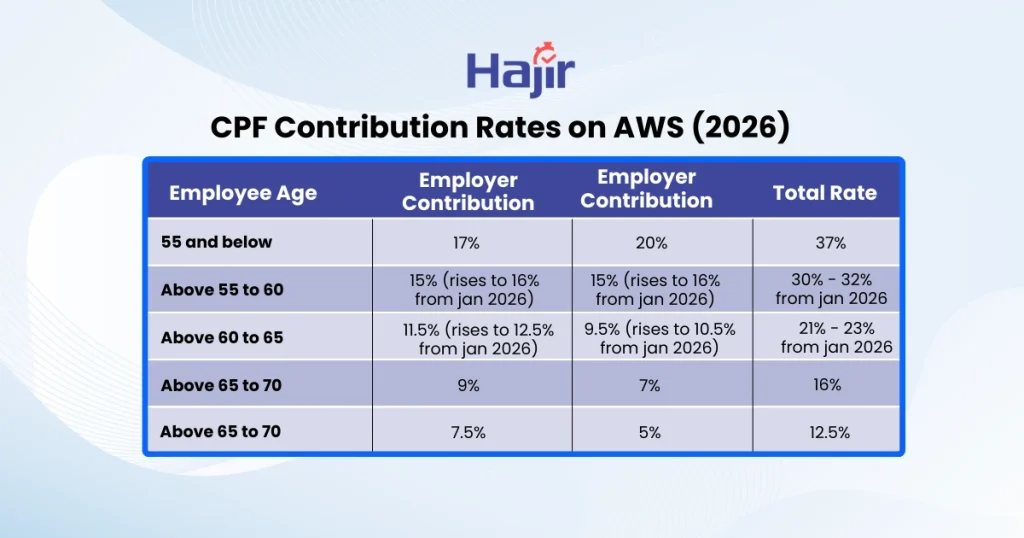
Note: Rates for the 56–65 age bands rise from January 2026. Different graduated rates apply to 1st and 2nd year PRs.
Employers submit CPF contributions on AWS to the CPF Board by the14th of the following month. CPF Board charges a penalty of 1.5% per month (minimum S$5) for late submissions.
For companies managing multi-country payrolls, explore HR Software for Multinational Companies to handle CPF, AWS, and statutory compliance efficiently.
Tax Treatment of AWS in Singapore
IRAS taxes AWS fully as employment income, applying the same progressive rates as monthly salaries. Special AWS-related tax exemptions and reliefs do not exist. The same progressive personal income tax rates apply to AWS as to your regular monthly salary.
IRAS Reporting Requirements for Employers
IRAS taxes AWS fully as employment income, without any special exemptions. The employers are required to record the AWS amount in theIR8A form submitted by the employee through the Auto-Inclusion Scheme (AIS) by1 March of the next year. AWS granted on December 2025, e.g., would have to be reflected in the IR8A filed by 1 March 2026.
AWS is also subject to theSkills Development Levy (SDL) at 0.25% on the first S$4,500 of monthly wages (minimum S$2, maximum S$11.25 per month).
Annual Wage Supplement vs Performance Bonus — Key Differences
A lot of employees and even human resource professionals tend to mix AWS with a performance bonus. The two are on two extreme ends and touching one the other way could result to payroll errors, staff complaints and contract rules.
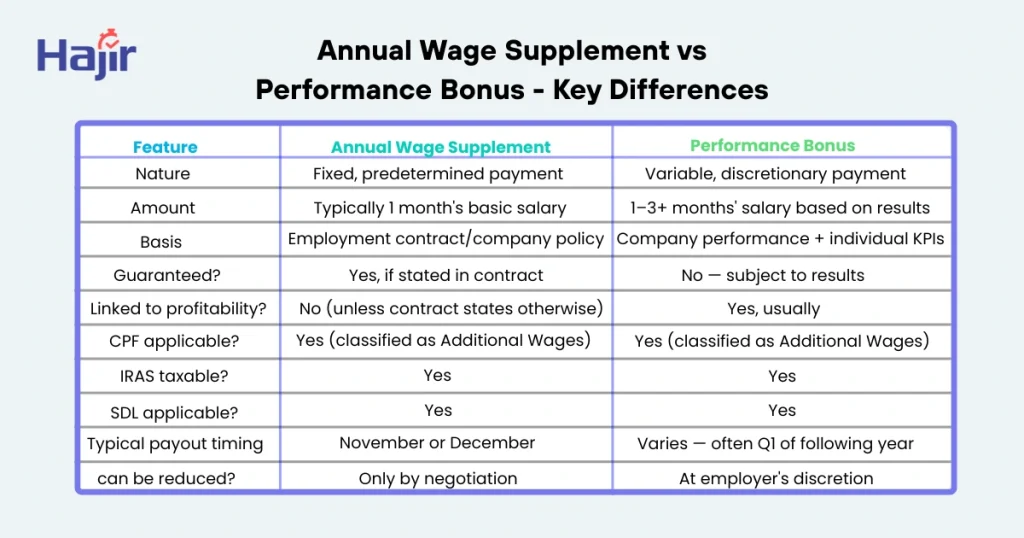
Learn how AWS aligns with performance tracking using KPI Tracking Software.
Job advertisements in Singapore often state“12 months + AWS” — this means 12 regular months plus one additional month as AWS, totalling 13 months of pay. It does not mean 12 months plus a variable bonus. HR teams writing job descriptions should use this notation precisely to avoid mismatched expectations at hire.
When and How is AWS Paid?
There is no legal deadline or fixed payment schedule for AWS under Singapore law. The timing is determined by the employer’s policy or the employment contract. In practice, the overwhelming majority of Singapore companies pay AWS in November or December, to align with the year-end festive season.
Some companies split the AWS payment into two tranches — typically 50% in June or July, and the remaining 50% in December. This approach can help employees manage mid-year financial needs while reducing the company’s December cash-flow pressure.
IRAS Reporting Requirements for Employers
- Communicate the AWS payout date to all employees at the beginning of the year — not at year-end. This will contain expectations and minimize HR enquiries during Q4.
- Use payroll software or a specialized AWS calculator to run the AWS calculation no less than 1 month before the payout date so that it can be reviewed and corrected.
- AWS- Process CPF contributions in the same payroll run (or in a separate off-cycle run) and submit to CPF Board by the 14 th of the next month.
- Prepare a separate payslip between AWS and ordinary salary and any performance bonus so as employees can see what each element of the payslip is.
- In the case of new employees who come in the middle of the year, the pro-rated AWS should be recorded and should only be paid out upon approval.
AWS in Different Countries
Although this guide is devoted to Singapore, the Annual Wage Supplement concept is represented in different types all over the world. This awareness of the global situation is applicable to HR departments that handle multi-country payrolls or to companies entering new markets.
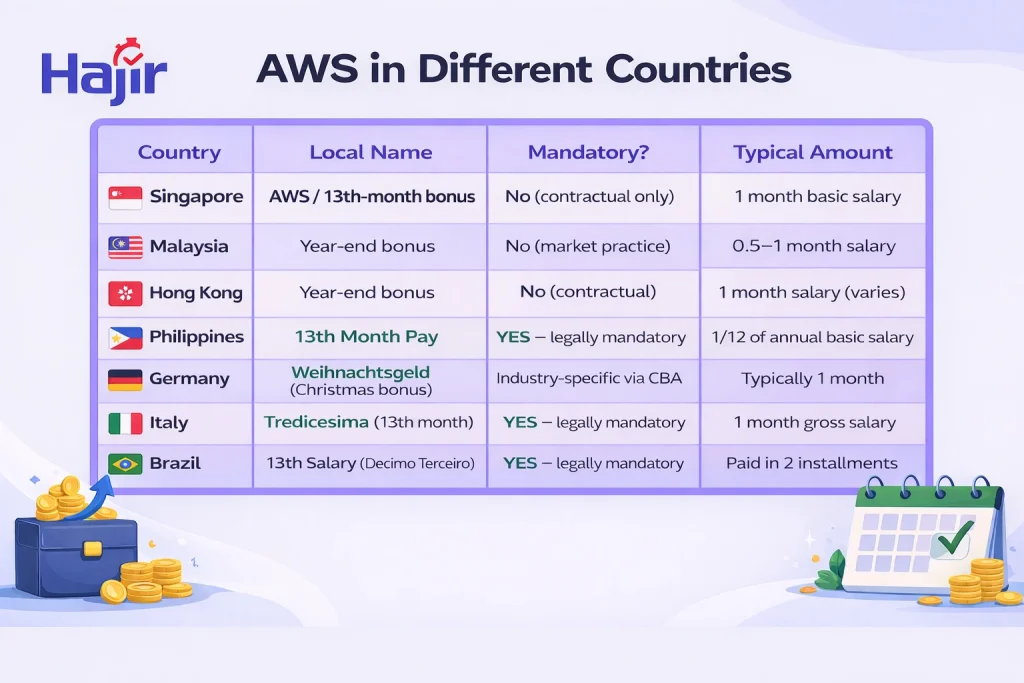
The key takeaway for Singapore employers: just because AWS is common practice does not make it legally required. However, in some countries, such as the Philippines, Italy and Brazil, however, the 13th-month equivalent has become a mandatory requirement – HR departments within the respective countries that handle payroll have no option but to comply with the legal requirement irrespective of wording in employment contracts.
Common Mistakes HR Teams Make When Processing AWS
At first glance, AWS seems straightforward — it simply adds one extra month of pay. But in practice, payroll teams make recurring errors that create CPF under-deductions, employee disputes, and IRAS compliance issues. The four most frequent mistakes and their avoidance are the following:
Mistake 1: Calculating AWS on Gross Salary Instead of Basic Salary
The mistake:HR teams calculate AWS based on the employee’s gross monthly salary (gross salary is the sum of all the allowances paid to the employee such as transport allowances, housing allowances, meal allowances and commissions).
The fix:HR calculates AWS based on basic salary only, unless the employment contract explicitly states otherwise. For a field employee earning S$3,000 basic + S$800 transport allowance, the AWS is S$3,000 — not S$3,800.
Mistake 2: Not Pro-Rating AWS for Mid-Year Joiners
The mistake:Paying the full one month AWS to employees who joined in August or September, without applying proration.
The fix:Apply either the monthly or daily proration method consistently for all employees who did not complete the full calendar year. Document the method in your HR policy.
Mistake 3: Not Checking the CPF Additional Wage Ceiling Before Processing
The mistake:HR applies CPF contributions to the full AWS amount without checking whether the employee has already reached the S$102,000 annual wage ceiling through ordinary wages and other additional wages paid earlier in the year.
The fix:Before processing December payroll, run a year-to-date check for each employee: calculate S$102,000 minus total OW subject to CPF for the year. The result is the maximum amount of AWS on which CPF is payable. Any AWS above this ceiling is CPF-exempt.
Mistake 4: Not Documenting AWS Policy in Employment Contracts
The mistake:Paying AWS every year without formally writing it into employment contracts, then trying to withhold it in a difficult year.
The fix:any employment agreement must expressly state: (a) the right to AWS, (b) the method of calculation (value and basis), (c) any conditions before eligibility to AWS (minimum service, status in probation) and (d) that the employer may vary AWS when the business is performing poorly, however, with consultation. Without this clause, consistent payment of AWS over multiple years can be treated as an implied contractual term that is difficult to rescind.
Avoid these by using automated tools and referring to Payroll Management Systems.
Conclusion
Annual Wage Supplement (AWS) is simple in concept: an extra month’s salary at year-end. However, it requires precise execution. Therefore, employers should properly record AWS in contracts, calculate proration correctly for mid-year hires, verify CPF Additional Wage ceilings, and schedule payments accurately. Workers are to keep in mind that AWS is not statutory but is a contract and it is important to make a review of the contract.
HajirHR’s payroll module automates AWS calculations, proration, CPF compliance checks, IR8A reporting, and payslip generation, eliminating manual errors and ensuring accurate, compliant year-end payroll. Explore HajirHR for a full HRMS solution.
FAQ
The Annual Wage Supplement, often called the 13-month bonus, is a fixed, year-end payment equal to one month of an employee's basic salary.
As stated on the Central Provident Fund (CPF) Board, the Annual Wage Supplement (AWS) falls under the category of "remuneration in money," encompassing bonuses, and is therefore subject to CPF contributions.
13th month pay – refers to 'one-twelfth of the total basic salary earned by an employee within a calendar. ' (2024 DOLE-BWC Handbook on Workers' Statutory Monetary Benefits or “DOLE-BWC Handbook”, p. 40.).
Resignation before payout: Employees who leave before AWS is disbursed typically forfeit it, unless their contract says otherwise. Many companies require staff to still be employed and not on notice during payout day. Probation or recent hires: Some companies only pay AWS to confirmed employees.
After around 15 days of non-payment: AWS warns you that your account will be suspended. Your services still run, but you might lose access to billing features and some console functionality.
Know more about HajirHR. Your All in one HR software.
Get started now!
Recent Post