If you are using Hajir V1 Kindly visit here for admin login.

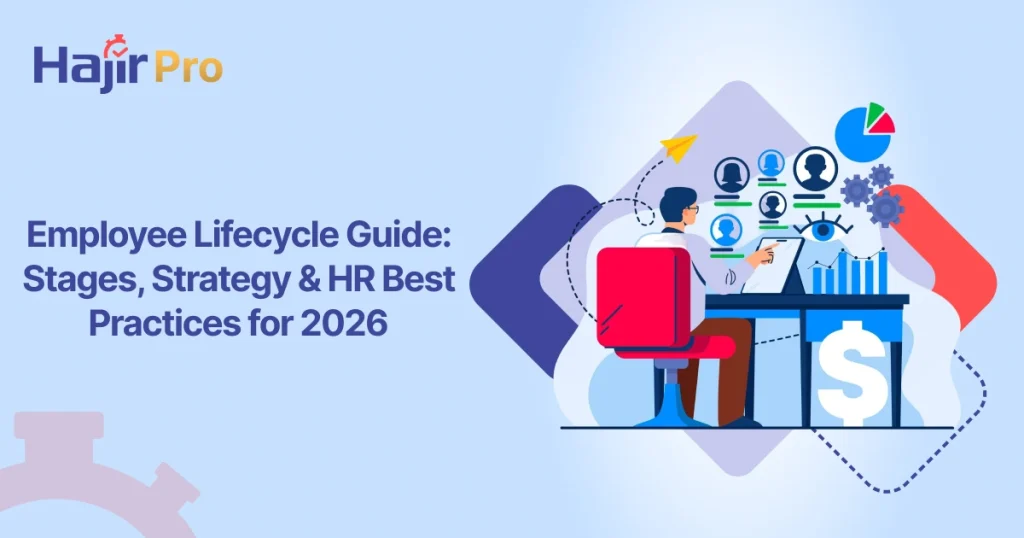
Employee Lifecycle Guide: Stages, Strategy & HR Best Practices for 2026
In the dynamic world of Human Resources, managing the lifecycle of the employee effectively is essential for ensuring organizational success. Theemployee lifecycle is a process of an employee in a firm, including attraction to off-boarding. By comprehending these stages, businesses can increase workforce experience, raise retention levels, and workforce productivity in general.
This article will provide an in-depth look at the six lifecycle stages of the employee, strategies for optimizing each stage, and the best HR practices for 2026. We shall discuss how the HRs can be able to maximize employee lifecycle to generate a successful workforce.
What is the Employee Lifecycle?
Employee lifecycle is defined as the successive stages that an employee experiences in his/her time of stay in a company, starting with recruitment up to the time of exit. It covers all the stages of the relationship of an employee with the organization and is important in determining the experience of an employee. Managing the lifecycle of the employee effectively helps organizations create an engaged, productive, and loyal workforce.
Importance of the Employee Lifecycle
Understanding and managing the lifecycle of the employee is essential for organizations looking to:
- Improveemployee retention andengagement.
- Optimizeworkforce productivity.
- Develop amore powerful employer brand which attracts the quality.
- Have a good working culture and provide a smooth flow of people in and out in terms of hiring, promotions and exit.
Through the proper handling of every stage, the businesses are able to improve their performance and achieve success in the long run.
Key Benefits of Managing the Employment Cycle
The successful management of the employee lifecycle has the following results:
- Employee Retention: The engaged employees are more productive and deliver more towards the success of the company.
- Improved Performance: Engaged employees are more productive and contribute more to the company’s success.
- Stronger Employer Brand: It is a strong lifecycle of employees that creates good experiences that attract the best candidates.
The 6 Stages of the Employee Lifecycle
Theemployee lifecycle consists of six main stages:Attraction,Recruitment,Onboarding,Development,Retention, andOffboarding. Let’s explore each stage in detail.
Stage 1: Attraction
Attraction is the first stage of the lifecycle of the employee, where organizations build their employer brand and attract potential talent.
Defining the Ideal Candidate
Identifying the skills, experience, and values that align with your company’s needs is crucial in this stage.
Strategies for Attracting Top Talent
- Leveraging social media and job platforms.
- Creating engaging job descriptions.
- Showcasing your company’s culture.
Tools and Methods for Talent Attraction
- Applicant Tracking Systems (ATS) has the potential to facilitate the recruitment procedure.
- Employer branding tools can help highlight company culture and values.
To learn more about the attraction of talents, refer to theBest HR Software guide that will assist in the recruitment process.
Stage 2: Recruitment
Recruitment entails the process of getting the right individuals by going through the pool of applicants.
Streamlining Recruitment Processes
A streamlined process helps reduce hiring time and improves candidate experience.
The Role of Technology in Recruitment
Modern tools likeAI-powered recruitment software andApplicant Tracking Systems (ATS) can speed up the process, improve decision-making, and ensure better candidate matches.
To learn more about recruitment tools, have a look atTop 10 HR Software.
Interviewing and Candidate Selection Strategies
- Interviewing through structured interviews increases consistency.
- The skills measurement can be used to measure qualifications through the use of skills assessments.
Stage 3: Onboarding
Onboarding preconditions the success of employees through the easy integration of newly recruited people into the organization.
Effective Onboarding Techniques
A good onboarding process ensures employees feel welcomed, informed, and engaged from day one.
Onboarding Software and Tools
The use of HR management software can be used to automate the administrative processes, which can be more personalized.
For more about onboarding, check out Employee Onboarding Guide.
Best Practices for Introducing New Hires to Company Culture
- Have a mentor to direct them around the organization.
- Provide clear expectations for the first 90 days.
Stage 4: Development
The development stage focuses on employee training and career growth.
Employee Training and Professional Development
Ongoing learning is one of the opportunities that employees get to learn new skills and stay motivated.
Performance Management Strategies
Feedback and well-stated goals are the key elements of the improvement of organizational efficiency and development.
Mentoring, Coaching, and Career Growth
The support offered by the leadership helps the employees to feel appreciated and motivation to achieve their potentials.
Stage 5: Retention
Retention is all about keeping top talent engaged and happy within the organization.
Strategies to Retain Top Talent
- Offering competitive salaries and benefits.
- Creating opportunities for career advancement.
Employee Engagement Programs
Effectiveemployee engagement programs lead to a more motivated and loyal workforce.
Reward and Recognition Systems
Regular appreciation of employee performance promotes the morale and loyalty.
To read more aboutengagement strategies of employees, refer toEmployee Engagement Strategies.
Stage 6: Offboarding
The last phase of employee lifecycle is off-boarding in which an employee leaves the company.
Managing the Employee Exit Process
A smooth exit process will take care of employees to leave under friendly terms without any negative relationship.
Importance of Exit Interviews
The exit interviews also give a good idea about the experience of the employees and could show where improvement can be made.
Handling Transitions to Maintain a Positive Relationship
Provide adequate transfer of knowledge and open communication during the transition stage.
To learn more about dealing with off-boarding, seePositive Offboarding Experience.
How HR Strategy Aligns with the Employee Lifecycle?
It is necessary to developHR strategy into every lifecycle stage to make sure that all phases work in harmony. Holistic HR strategy ensures there is attraction, development and retention of talent.
The Role of HR Tech in Enhancing the Lifecycle
Modern HR technology enhances each stage of the lifecycle of the employee:
- Applicant Tracking Systems (ATS) streamline recruitment.
- HR software improves the performance management and retention practices.
For a comprehensiveHR software solution, explore All-in-One HR Software.
Best Practices for Optimizing the Employment Cycle
The employment lifecycle can be improved with the help of strategies and practices. These include:
- Policies that areemployee-focused and emphasize the needs and satisfaction of employees.
- On-going feedback mechanismsto ensure constant improvement.
- Employee wellbeing programs in order to promote work-life balance.
Using Data to Improve the Lifecycle of Employee
Making decisions based on data plays a key role in maximizing the employee life cycle. Important indicators, including employee satisfaction ratings and turnover, provide practical information that the HR departments can utilize to improve every step.
Learn how to use data to drive improvements by reading KPI Tracking Software.
Most Common Employment Cycle Mistakes to Avoid
There are several pitfalls that HR professionals must avoid to ensure the smooth progression of the lifecycle of the employee:
- Poor onboarding can lead to disengagement.
- Neglecting offboarding can damage the company’s reputation.
Read the article on overcoming the usual HR problems in theOvercoming HR Challenges post.
Employee Lifecycle Trends for 2026
As we move into 2026, several trends are emerging in the lifecycle of the employee:
- The rise ofAI and automation in recruitment and performance management.
- The growth of remote working and the related implications on employee retention and engagement.
Conclusion
Theemployee lifecycle is a significant aspect that should be understood and managed in order to develop a successful workforce. Though strategies and use of technology at every level can help organizations improve employee experience, retention, and eventually drive business success.
To get more materials on how to optimize HR processes, visitHajir HR Solutions.
FAQ
There are five main steps of the employee lifecycle, which are Attraction, Recruitment, Onboarding, Development, and Retention.
When the stages are effectively controlled, businesses will be able to augment the engagement and satisfaction, resulting in the high retention rates.
Onboarding and Retention are key stages in determining long-term employee success and loyalty.
HR software likeperformance management systems andapplicant tracking systems can make every step more efficient and quick.
Use metrics such as employee engagement scores, retention rates, and performance evaluations.
Know more about HajirHR. Your All in one HR software.
Get started now!
Recent Post