How Many Hours in a Year Do Employees Actually Work?
Whether you are an HR manager running payroll, a business owner planning budgets, or an employee reviewing your workload, understandinghow many hours in a year the employee works is essential. Additionally, it affects salary calculations, legal compliance, and workforce wellbeing.
We will de-annualize the working hours, define the working hours, examine various working models, and demonstrate howHajir HR – a reputable HR service to help companies grow globally can assist over 1,600 organizations to track and manage each single working hour with accuracy
What is the Standard Workweek?
The most popular standard that is applied in industries and nations is the 40-hour workweek – 8 hours a day, 5 days a week. However, the actual definition of a “standard workweek” varies based on:
- Country and regional labor laws
- Industry type (healthcare, manufacturing, retail, tech, etc.)
- Organizational culture (fixed vs. flexible hours)
Across different regions, labor laws define maximum working hours, overtime limits, and rest periods. Therefore, HR teams must track these rules carefully to stay compliant.
How Many Hours in a Year Do Employees Work? The Simple Calculation
The formula for calculating annual working hours is straightforward:
Weekly Hours × Total Weeks in a Year = Annual Working Hours
40 hours × 52 weeks = 2,080 hours per year
This is the baseline for a full-time employee working the standard 5-day, 8-hour workweek with no time off. However, once you subtract public holidays and paid time off, the actual hours become lower.
Breaking Down Annual Working Hours
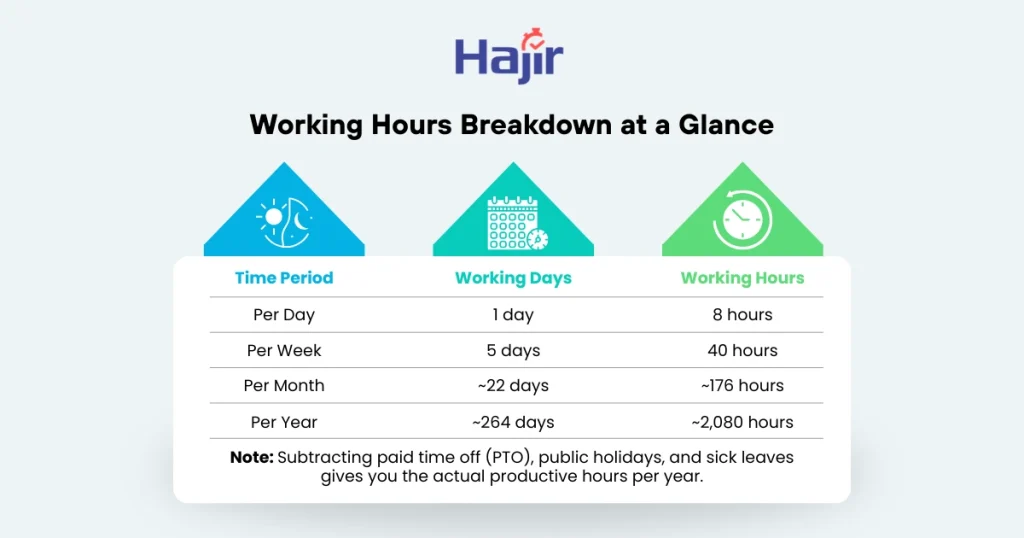
Average Working Hours Per Day
The international standard is8 hours a day of working. Nevertheless, such industries as healthcare might have longer shifts. In addition, there are daily limits and required rest periods which are stipulated by most labor laws.
Average Working Days Per Week
Most organizations follow a5-day workweek (Monday-Friday). On the other hand, sectors like hospitality and construction often operate six days per week.
Average Working Days Per Month
With approximately22 working days per month (based on a 5-day week and accounting for public holidays), employees log around176 hours monthly.
Average Working Days Per Year
According to the 5 day work week system, the average number of days worked by employees every year is264 days (excluding leave and holidays).
Beyond the Standard: Alternative Workweek Models
Modern organizations are rethinking the traditional 9-to-5. Here are the most common alternative arrangements:
1. Shift-Based Workweek
Theshift-based model is common in hospitals, hotels, and call centers. In this setup, the day is divided into morning, evening, and night shifts. Workers are assigned to different positions depending on the business requirements and the weekly working hours can be less than the normal 40 hours.
Hajir HR’sShift Management Software supports dynamic duty rosters, shift-wise overtime, multi-shift configurations, and real-time shift notifications – making it effortless to manage complex rotating schedules across all your branches.
2. Compressed Workweek
In acompressed workweek, employees complete 40 hours in fewer days. For example, they may work four 10-hour shifts. This provides a 3 day weekend to the employees and allows productivity.
3. Four-Day Workweek (32-Hour Model)
The newfour day, 32 hour working modelfocuses on productivity rather than time spent. As a result, companies often report lower burnout. The implementers across the world have reported increased focus and reduced burnouts and increased employee retention.
4. Flexible Working Hours
Withflexible hours, employees choose their start and end times as long as they meet daily or weekly hour targets. This model gives more emphasis on results as compared to clock watching, and is becoming more and more popular in IT and consultancy industries as well creative industries.
Legal Considerations: How Labor Laws Govern Working Hours
It is very important to know the legal framework of working hours in order to comply. Three major areas consider it in the following way:
No matter where your business operates, understanding labor laws is essential. For example, different countries set limits on daily hours, overtime, and rest periods:
1. India
India’sFactories Act of 1948 limits factory workers to9 hours per day and 48 hours per week, with overtime compensation at nearly double the regular rate. Other categories of workers are covered under the IndustrialEmployment Standing Orders Act of 1946 andShops and Establishments Act.
2. USA
TheFair Labor Standards Act (FLSA) requires the overtime payments of employees who work in excess of40 hours a week.Family and Medical Leave Act (FMLA) gives qualified employees up to 12 weeks of unpaid leave during a minimum of 12 months.
3. UK
TheWorking Time Regulations 1998 limit employees to an average of48 hours per week (calculated over a 17-week reference period), unless they opt out in writing. The employees are also entitled to not less than 11 consecutive hours of drop per day and 28 days of paid yearly vacation.
4. UAE
The UAEFederal Decree Law No. 33 of 2021, in Art. 17, allows employees in the private sector to work not more than8 hours a day having a minimum rest of one hour.In any case, there is a limit of 2 extra hours per day.
5. Singapore
Discusses theEmployment Act limits (8 hrs/day, 44 hrs/week), the72-hour monthly maximum of overtime, the rates of overtime compensation (1.5 times), the required rest days as well as theenforcement of the MOM.
6. Nepal
Covers theLabor Act 2074 limits (8 hrs/day, 48 hrs/week),1.5x overtime payment, rest day rights, public holidays, Department of labour compliance, and a natural reference that Hajir HR will keep businesses in Nepal afloat.
Why Tracking Annual Working Hours Matters?
This is not simply a legal requirement to have the number of hours the employees work in a year accurately tracked: this has a direct effect on the health of your business:
Payroll Accuracy: Accurate hour tracking ensures correct salary calculations. Therefore, it prevents costly payroll errors.
Budget Planning: Knowing actual labor hours helps HR plan headcount and compensation. As a result, financial forecasting becomes more reliable.
Employee Wellbeing: Consistently high hours indicate burnout risk. With proper tracking, managers can redistribute workloads early.
Compliance: Real-time monitoring helps avoid fines and legal issues. Thus, organizations stay aligned with labor laws.
Performance Insights: Comparing hours worked with output reveals inefficiencies. Additionally, it helps identify top performers.
How Hajir HR Makes Working Hour Management Effortless?
Hajir HR is an intelligent cloud-based HR management solution with the confidence of1,600+ organizations and10,000+ active users in the healthcare, education, manufacturing, hospitality, IT, finance sectors, and others – allowing teams around the globe to confidently run their workforce.
Here’s how Hajir takes the complexity out of managing employee working hours:
Time & Attendance Tracking
Hajir supportsWiFi, QR code, Geo-Fencing,Biometric Integration, and Remote clock-ins. As a result, you get real-time visibility into attendance. Attendance policies, overriding rules, and overtime thresholds are all configurable.
Shift Management
Plan, schedule, and notify employees of their shifts in seconds. Hajir supportsfixed and flexible shifts, multi-shift configurations, dynamic duty rosters, and shift-wise overtime – essential for businesses running round-the-clock operations.
Leave & Holiday Management
Auto-track approved leave and holidays to determine the perfect working hours calculation. Hajir has policies that favor global and custom leave, carry-forward policies, half-day leaves, substitute leaves, and others.
Payroll Management
The payroll engine created by Hajir based on the real time attendance information will give it the correct salary calculation – including working hours, overtime, deduction of leave, tax (TDS, SSF, PF, CIT) and allowances.Process 99.99% of payrollsautomatically.
Dynamic Reports
Generate33+ different reports. Moreover, you gain clear insights into attendance, payroll, and productivity – to have complete insight into your workforce hours and productivity.
Live Tracking & Field Force Management
For businesses with field staff, Hajir providesGPS-based live tracking, activity monitoring, and area-wise mapping to ensure hours logged in the field are accurate and verifiable.
Event & Notification Management
Never miss an overtime threshold, a missed punch, or a policy violation. Hajir sends automated notifications to employees and managers for attendance anomalies, upcoming shifts, and leave approvals.
Practical Example: Calculating Net Annual Hours with Hajir
Let’s say your organization follows a standard 40-hour workweek with the following typical leave entitlements:
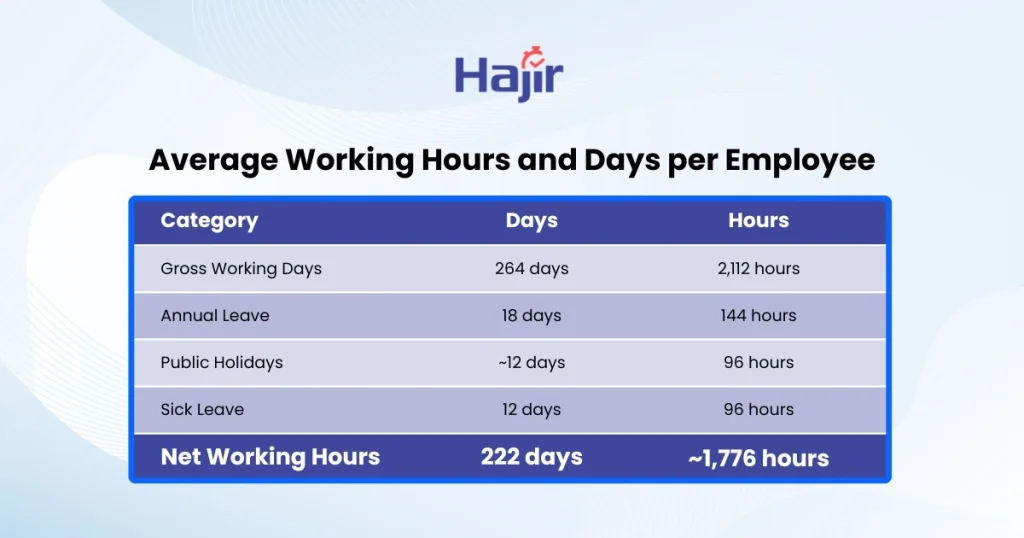
With HajirHR, this calculation is fully automated. Consequently, payroll uses real attendance data instead of estimates. This saves HR teams significant time.
Wrapping Up
One of HR’s core responsibilities is understandinghow many hours in a year employees actually work. Ultimately, this supports payroll accuracy, compliance, and workforce planning.. The standard 2,080-hour baseline is a starting point – but net productive hours, overtime, leave, shift patterns, and legal compliance all shape the real picture.
For organizations of any size, anywhere in the world,HajirHR provides the tools to track every hour with accuracy, automate payroll, manage shifts and leave, and stay compliant – all from a single, cloud-based platform available on Web, iOS, and Android.
FAQ
When the number of an average full time employee who works 40 hours a week and takes 52 weeks of leave are combined, the figure equals2,080 hours per year without taking into consideration the leaves and holidays.
Divide the gross 2,080 hours starting point by the total hours of leave (annual leave, public holidays, and sick leave). This is automatically calculated with Hajir HR using real-time attendance information.
This varies by country - for example, 8 hours/day in the USA and UAE, up to 9 hours/day in India, and an average 48-hour weekly cap in the UK. Hajir HR helps organizations stay compliant by automatically flagging overtime based on configurable thresholds.
Yes, a 32-hour, 4-day workweek results in approximately1,664 hours per year compared to the standard 2,080 - a reduction of over 400 hours annually.
The Hajir HR offers real-time attendance notifications, automatic overtime notification, shift-based reporting, and dynamic calculation of payrolls - and HR teams have all they need to keep the compliance and provide the appropriate payroll processing based on hours.
Know more about HajirHR. Your All in one HR software.
Get started now!
Recent Post